Het wereldwijde magazine en verkoopplatform voor liefhebbers van klassieke auto’s, door liefhebbers.
Het wereldwijde magazine en verkoopplatform voor liefhebbers van klassieke auto’s, door liefhebbers.


Maak een keuze
- Auto's
-
Merk >>
-
Bouwjaar >>
-
-
Categorie >>
- Motorfietsen
-
Bouwjaar >>
-
- Onderdelen
-
Automerk >>
-
Fabrikant >>
-
Categorie >>
-
Landen



De marktplaats: alle oldtimers te koop
Overzicht van gerelateerde advertenties 1948 Jaguar Mk IV 3½ litre
-

1947 Jaguar Mk. IV Saloon | Windsorview Lakes 16th July 2022 Sale | Historics Auctioneers
The 1945-1948 Jaguar Mk. IV was Jaguar's first car after World War II and were essentially continuations of the 1938-39 models. Very few of these cars were built for the right hand drive markets as steel was being rationed for goods for export. The origin of the name is rather odd since, back in 1948, there had been no Mk. I to IV Jaguars; the Mk. ..JaguarMk. IV SaloonVERKOCHT -
1966 Jaguar Mk. II (3.4 Litre) | Windsorview Lakes 16th July 2022 Sale | Historics Auctioneers
Synonymous with the swinging `60s and the hit TV Series Inspector Morse, the Mk. II was undoubtedly the most admired Saloon to emanate from Jaguar's hallowed Browns Lane factory. Featuring notably slimmer roof pillars than its Mk. I predecessor, the immortal Mk. II was as airy on the inside as it was elegant on the outside. The interior was quintes..JaguarMk. II (3.4 Litre)VERKOCHT -
1964 Jaguar Mk. II (3.8 Litre) | Windsorview Lakes 16th July 2022 Sale | Historics Auctioneers
The Jaguar Mk. II was a medium sized saloon built from 1959 to 1967 as a successor to the 2.4 and 3.4 litre models. The Mk. II was handsome, powerful, and good handling saloon which was offered with a choice of three six-cylinder twin cam engines; 2.4 litre, 3.4 litre or 3.8 litre. After the appreciation of the Mk. I, Jaguar's successor was well re..JaguarMk. II (3.8 Litre)VERKOCHT -
2004 Jaguar XJR | Windsorview Lakes 16th July 2022 Sale | Historics Auctioneers
The Jaguar XJ (X350) is a luxury saloon manufactured between 2003–2009 as the third generation of the Jaguar XJ saloon — carrying the internal designation X350. Both the X350 and X358 were available with a six-speed automatic transmission, a range of petrol and diesel engines (V6, V8 and supercharged V8), numerous trim levels — and short wheelbase ..JaguarXJRVERKOCHT -
1968 Jaguar 240 | Windsorview Lakes 16th July 2022 Sale | Historics Auctioneers
The lineage of the Mk. II can be directly traced back to its predecessor, the 2.4 saloon or Mk. I as it would come to be known in later years. This sporting saloon, designed to fill the gap in Jaguar's range between the XK sports and the voluminous Mk. VII, entered the market in 1956. Power came from the legendary XK straight six, twin cam engine i..Jaguar240VERKOCHT -
1994 Jaguar XJS Convertible | Windsorview Lakes 16th July 2022 Sale | Historics Auctioneers
The Jaguar XJS offers its owners a slice of well deserved motoring history - defying critics, as it did, to become one of the world's most successful GT cars. From the introduction of the HE engine in 1982, the 3.6 AJ6 engine in 1984 which expanded to four litres in 1989, the cabriolet in 1985, the full convertible in 1988 and the face-lift model i..JaguarXJS ConvertibleVERKOCHT -
1949 Maserati A6 1500/3C | Hyman LTD
The Fratelli Maserati are woven into the very fabric of Italian motorsport history. Highly respected as engineers, designers, drivers, and team managers, motorsport was their first and only love, and, like Enzo Ferrari, they only saw road cars as a means to an end. Despite being involved in racing since the 1920s, it was not until a partnership wit..1949MaseratiA6 1500/3CVERKOCHT -
1974 JAGUAR XKE ROADSTER
In the middle of the 1960s, Jaguar engineers were busy trying to keep pace with continually evolving safety and emissions regulations. Increasingly strict standards, particularly in the critical American market, saw the power and purity of the original E-Type gradually compromised. Jaguar knew the E-Type could not continue in its original form f..1974JaguarXKE RoadsterVERKOCHTLocatie: Verenigde Staten -
Jaguar - XK 140 FHC SE
Jaguar XK 140 FHC Special Equipment car totally restored in 1989 and still in impeccable condition today. It has the Jaguar Heritage and ASI gold homologation. Matching numbers and matching colors. The car is a real Special Equipment differs from the standard versions for the engine with CTYPE cylinder head, fog lights, dual exhaust, painted spo..1955JaguarXK 140 FHC SEVERKOCHTLocatie: Italië -
Jaguar XK120 OTS Nice car
Nice, good-running Jaguar XK120 OTS.This is a popular early copy from 1950.Originally delivered in America and recently came to the Netherlands. Never completely restored. Many original details are still present such as wheelspats, dashboard and clocks.The beautiful Two-tone interior has been updated in the pas..1950JaguarXK120 OTSVERKOCHTLocatie: Nederland


Uitgelicht
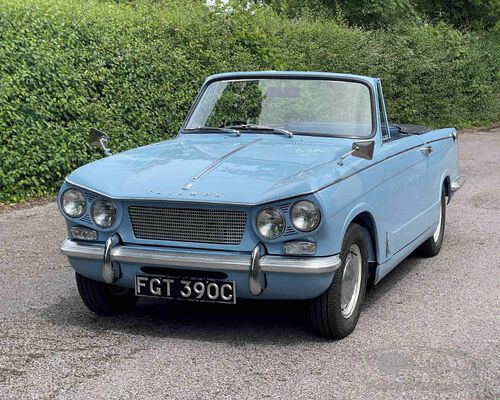
Triumph Vitesse 6 Convertible
Technische specificatiesMerk & model: Triumph Vitesse 6 ConvertibleBouwjaar: 1965Kenteken: Britse registratie
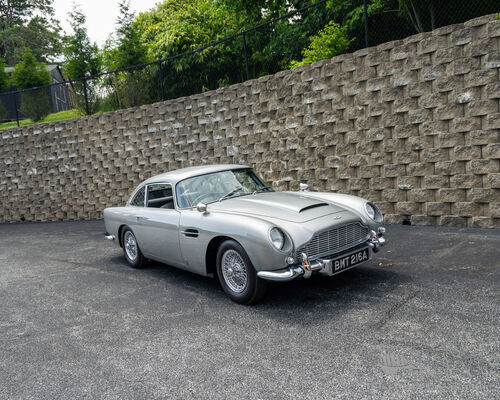
2020 Aston Martin DB5 Goldfinger Continuation
Wordt geveild door RM Sotheby's tijdens The Monterey Auction, 13–15 augustus 2026. Geschatte opbrengst: USD 1.000.000 – 1.500.000..
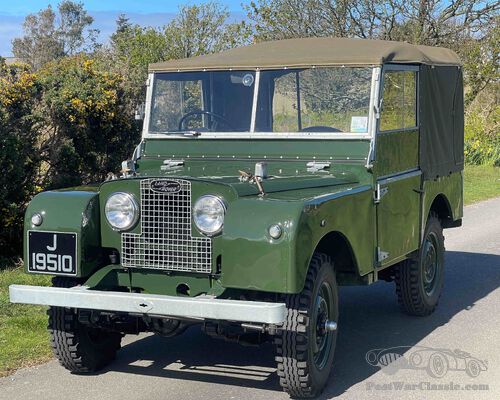
1952 Land Rover Series 1
Technische specificaties:Merk en model: Land Rover Series !Bouwjaar: 1952Kenteken: geregistreerd in ..