Het wereldwijde magazine en verkoopplatform voor liefhebbers van klassieke auto’s, door liefhebbers.
Het wereldwijde magazine en verkoopplatform voor liefhebbers van klassieke auto’s, door liefhebbers.


Maak een keuze
- Auto's
-
Merk >>
-
Bouwjaar >>
-
-
Categorie >>
- Motorfietsen
-
Bouwjaar >>
-
- Onderdelen
-
Automerk >>
-
Fabrikant >>
-
Categorie >>
-
Landen



De marktplaats: alle oldtimers te koop
Overzicht van gerelateerde advertenties 1948 Jaguar Mk IV 3½ litre
-

1961 Jaguar E-Type Series I 3.8 'Flat Floor' Roadster | The Amelia Island Auction | Bonhams | 3 Mar 2022
3,781cc DOHC Inline 6-Cylinder Engine 3 SU Carburetors 265bhp at 5,500rpm 4-Speed Manual Transmission 4-Wheel Independent Suspension 4-Wheel Disc Brakes *Subject of a four-year restoration *Delivered new to New York *Rare and desirable flat floor, welded bonnet louver example *Offered with Jaguar Heritage Trust Certificate and history fileJaguarE-Type Series I 3.8 Flat Floor RoadsterVERKOCHT -
1957 Jaguar XK140 SE Fixed Head Coupe | The Amelia Island Auction | Bonhams | 3 Mar 2022
3,781cc DOHC Inline 6-Cylinder Engine (see text) 2 SU Carburetors 220bhp at 5,500rpm (see text) 3-Speed BorgWarner Automatic Transmission Front Independent Suspension - Live Rear Axle 4-Wheel Drum Brakes *Reported to be one of only three left-drive, automatic XK140 FHCs built in 1957 *Upgraded to a torquier 3.8-liter engine *Delivered new ..JaguarXK140 SE Fixed Head CoupeVERKOCHT -
1949 Rolls-Royce Silver Wraith H. J. Mulliner Sedanca de Ville WDC36
A handsome and unusual car,being a post-war Sedanca de Ville – a design more associated with an earlierera. The car is in good, sound general condition and runs well, but wouldbenefit from a certain amount of cosmetic improvement, including under thebonnet. Paintwork is fairly old but perfectly usable and the..1949Rolls-RoyceSilver Wraith H J Mulliner Sedanca de VilleVERKOCHTLocatie: Verenigd Koningkrijk -
1993 Jaguar Lister XJ12 | Ascot Racecourse 12th March 2022 Sale | Historic Auctioneers
The Jaguar XJ40 was manufactured between 1986 and 1994. Officially unveiled on 8th October 1986 it was an all-new redesign of the XJ to replace the Series III, although the two model ranges were sold concurrently until the Series III was discontinued in 1992. Lister Cars Limited took the standard XJ12 and offered a comprehensive range of upgrades i..JaguarLister XJ12VERKOCHT -
2000 Jaguar XKR Coupé | Ascot Racecourse 12th March 2022 Sale | Historic Auctioneers
The XK8 is a grand tourer car that was launched in 1996 and was the first generation of a new XK series available in either coupé or convertible body styles and with the new 4.0 litre Jaguar AJ-V8 engine. The 1998 XKR was introduced with a supercharged version of the engine. Both the XK8 and XKR are electronically limited to a maximum of 155mph, th..JaguarXKR CoupéVERKOCHT -
1966 Jaguar E-Type Series I 2+2 Coupé (4.2 Litre) | Ascot Racecourse 12th March 2022 Sale | Historic Auctioneers
The E-Type design owed much to that of the racing D-Type, a monocoque tub forming the main structure while a tubular spaceframe extended forwards to support the engine. Conceived and developed as an open sportscar, the Jaguar E-Type debuted at the Geneva Motor Show in March 1961 in Coupé form. The car caused a sensation, spontaneous applause breaki..JaguarE-Type Series I 2+2 Coupé (4.2 Litre)VERKOCHT -
2000 Jaguar XKR Convertible | Ascot Racecourse 12th March 2022 Sale | Historic Auctioneers
The XKR was launched in 1998 following the successful launch of the XK8 two years earlier. This supercharged version of Jaguars 4.0 litre AJ-V8 proved popular immediately. This new model produced an extra 100 bhp with the addition of an Eaton supercharger. With an impressive level of factory equipment that led Jeremy Clarkson to comment during a To..JaguarXKR ConvertibleVERKOCHT -
1974 Jaguar E-Type Series III | Ascot Racecourse 12th March 2022 Sale | Historic Auctioneers
The E-Type Series III was introduced in 1971, with a new 5.3 litre, V12 engine, uprated brakes, and standard power steering. Optionally, an automatic transmission, wire wheels and air conditioning were available. The brand new V12 engine produced 272bhp, had more torque, and a 0-60mph acceleration of less than seven seconds, which was phenomenal fo..JaguarE-Type Series IIIVERKOCHT -
1998 Jaguar XK8 Coupé | Ascot Racecourse 12th March 2022 Sale | Historic Auctioneers
Jaguar was founded as the Swallow Sidecar Company by Sir William Lyons in 1922, originally making motorcycle sidecars before developing passenger cars. The name was changed to Jaguar after World War II to avoid the unfavourable connotations of the SS initials. Sale to BMC happened in 1966, which in 1968 merged with Leyland Motor Corporation and bec..JaguarXK8 CoupéVERKOCHT -
1990 Jaguar XJS Convertible | Ascot Racecourse 12th March 2022 Sale | Historic Auctioneers
1975 saw the launch of the Jaguar XJS. In a year that Margaret Thatcher was made the leader of the Conservative Party and petrol was 70p/gallon, the new grand tourer from Jaguar was introduced as the replacement for the iconic E-Type. During an astonishing build run of 21 years, 115,413 units were produced by the Coventry manufacturer at their worl..JaguarXJS ConvertibleVERKOCHT





Uitgelicht
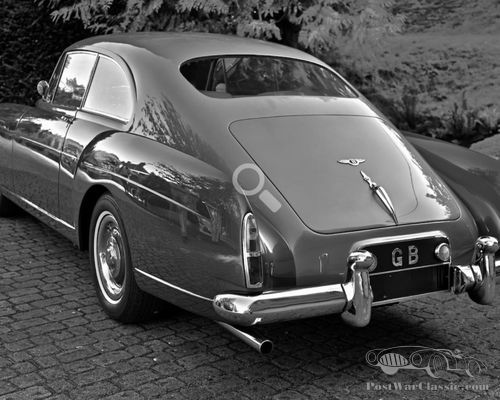
1957 Bentley S1 Fastback door H.J. Mulliner.
1957 Bentley S1 Fastback by H.J. Mulliner.Recent volledig gerestaureerd en bekroond exemplaar, in een staat die vrijwel gelijk is aan nieuw...
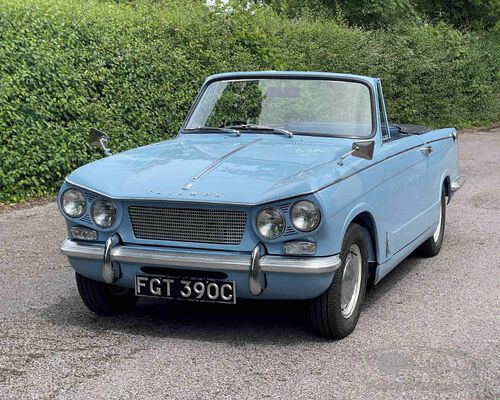
Triumph Vitesse 6 Convertible
Technische specificatiesMerk & model: Triumph Vitesse 6 ConvertibleBouwjaar: 1965Kenteken: Britse registratie
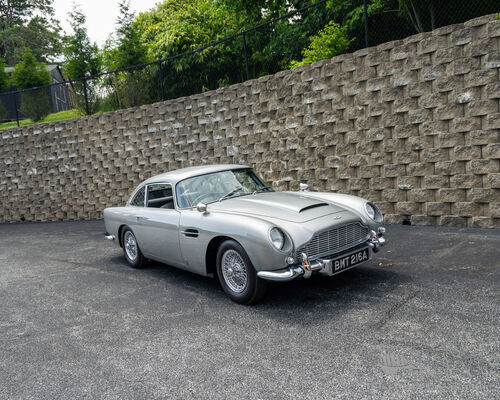
2020 Aston Martin DB5 Goldfinger Continuation
Wordt geveild door RM Sotheby's tijdens The Monterey Auction, 13–15 augustus 2026. Geschatte opbrengst: USD 1.000.000 – 1.500.000..