Het wereldwijde magazine en verkoopplatform voor liefhebbers van klassieke auto’s, door liefhebbers.
Het wereldwijde magazine en verkoopplatform voor liefhebbers van klassieke auto’s, door liefhebbers.


Maak een keuze
- Auto's
-
Merk >>
-
Bouwjaar >>
-
-
Categorie >>
- Motorfietsen
-
Bouwjaar >>
-
- Onderdelen
-
Automerk >>
-
Fabrikant >>
-
Categorie >>
-
Landen



De marktplaats: alle oldtimers te koop
Overzicht van gerelateerde advertenties 1949 Rolls Royce Silver Wraith by Vincents of Reading
-

1955 Rolls-Royce Silver Wraith Automatic LWB James Young Saloon.
A nicely sound,correct and appealing example of the James Young WRM31A design, with aparticularly elegant, sweeping tail. The car has been with one owner for nearlythirty years, and has well known names in its fascinating history. The car isrunning very well, driving nicely, and well preserved, with an appealing air oforiginality. The p..1955Rolls-RoyceSilver Wraith Automatic LWB James Young SaloonVERKOCHTLocatie: Verenigd Koningkrijk -
1979 Rolls-Royce Silver Shadow II | Ascot Racecourse Sale | Historics Auctioneers | 21st May 2022
When the Rolls-Royce Silver Shadow was released to the public in October 1965, the development departments were showing the result of work carried out over a period of some ten years. The new models were technically striking in three ways. A monocoque chassis was used; all wheels were sprung independently and four-wheel disc brakes now ensured stop..Rolls-RoyceSilver Shadow IIVERKOCHT -
1987 Rolls-Royce Corniche Convertible | Ascot Racecourse Sale | Historics Auctioneers | 21st May 2022
The Corniche was a development of the Rolls-Royce Silver Shadow, with the two-door variants of that model marketed as the 'Silver Shadow Mulliner Park Ward two-door fixedhead coupé and drophead coupé' until March 1966, when the Corniche name was applied. The exterior design was by John Polwhele Blatchley. The model was assembled and finished in Lon..Rolls-RoyceCorniche ConvertibleVERKOCHT -
1973 Rolls-Royce Phantom VI | Ascot Racecourse Sale | Historics Auctioneers | 21st May 2022
Introduced alongside the Silver Cloud II and Bentley S2 in the Autumn of 1959, Rolls-Royce's new limousine model, the long-wheelbase Phantom V, effectively replaced both the royalty/heads-of-state-only Phantom IV and the Silver Wraith. The latter's relatively short wheelbase (for a limousine) had made it all but impossible for coachbuilders to prov..Rolls-RoycePhantom VIVERKOCHT -
2005 Rolls-Royce Phantom VII | Ascot Racecourse Sale | Historics Auctioneers | 21st May 2022
A historic model in the continuing history of the Rolls-Royce marque, the Phantom was the first all new design to be introduced by the company following its takeover by BMW. Produced at a new factory near Goodwood in Sussex, the Phantom revived a great name from Rolls-Royce's past that had always been synonymous with unrestrained luxury. In keeping..Rolls-RoycePhantom VIIVERKOCHT -
1974 Rolls-Royce Corniche Convertible | Ascot Racecourse Sale | Historics Auctioneers | 21st May 2022
The Corniche was manufactured by Rolls-Royce between 1971 and 1996 in both coupé and convertible forms. Assembled and finished by Mulliner Park Ward, London, the Corniche was a continuation of the 1965 Silver Shadow and 1967 drop head coupé and, in 1971, the Corniche name was applied. Power was supplied by the Rolls-Royce V8 configured 6.7 litre en..Rolls-RoyceCorniche ConvertibleVERKOCHT -
1969 Rolls-Royce Phantom VI | Ascot Racecourse Sale | Historics Auctioneers | 21st May 2022
The Phantom VI was an ultra-exclusive rolling chassis made from 1968-1990. From 1968 to 1973 it was manufactured by Rolls-Royce Ltd., and during 1973-1990, by its successor, Rolls-Royce Motors. Most of the whole production of 374 units were bodied as limousines, a few landaulettes (12), and at least one as a convertible, and some hearses (4). The ..Rolls-RoycePhantom VIVERKOCHT -
1978 Rolls-Royce Silver Shadow II | Ascot Racecourse Sale | Historics Auctioneers | 21st May 2022
The Rolls-Royce Silver Shadow was released to the public in October 1965. This new model was ten years in development and the new series was characterised by surprisingly modern features. Rolls-Royce broke new ground and broke away from many sacred design principles. The new models were technically striking in three ways; a monocoque chassis was us..Rolls-RoyceSilver Shadow IIVERKOCHT -
1976 Rolls-Royce Silver Shadow I | Ascot Racecourse Sale | Historics Auctioneers | 21st May 2022
The Rolls-Royce Silver Shadow was a luxury saloon car built from 1965 through to 1980 and was the first Rolls-Royce to be constructed using a monocoque chassis and, to date, has the largest production volume of any Rolls-Royce. The original Shadow was 3½ inches narrower and seven inches shorter than its predecessor, the Silver Cloud, but managed to..Rolls-RoyceSilver Shadow IVERKOCHT -
1949 Delahaye 135MS Letourneur Et Marchand Coupe
1949 Delahaye 135MS Letourneur Et Marchand CoupeIn the years leading up to World War II, Delahaye enjoyed elite status among the top French automakers, earning its lauded reputation for quality and performance at LeMans and on the Grand Prix circuit. In 1935, the firm introduced one of its most successful models, the Type 135. A na..1949Delahaye135MSVERKOCHTLocatie: Verenigde Staten


Uitgelicht
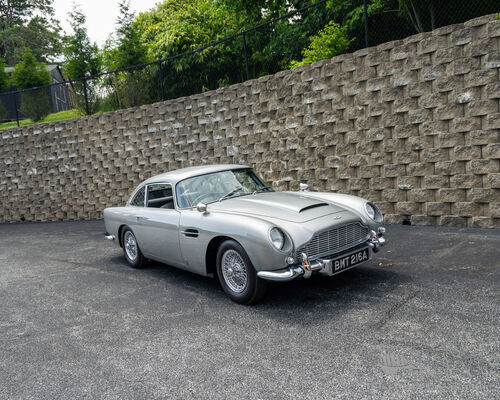
2020 Aston Martin DB5 Goldfinger Continuation | RM Sotheby's | The Monterey Auction
To Be OFFERED AT AUCTION at RM Sothebys' The Monterey Auction event, 13 - 15 August 2026. $1,000,000 - $1,500,000 USD One of 25 examples co..
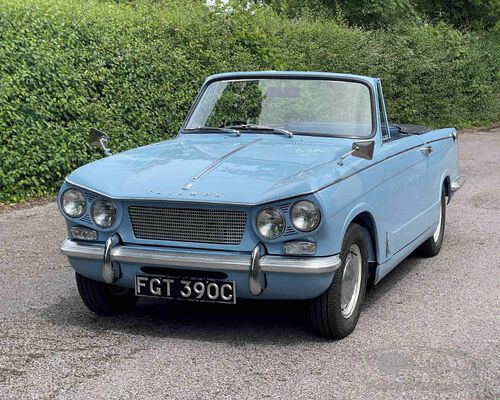
Triumph Vitesse 6 Convertible
Technical SpecificationsMark & Model: Triumph Vitesse 6 ConvertibleYear: 1965Registration plate: UK registered
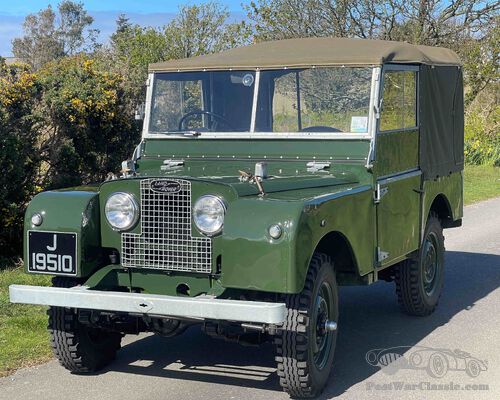
1952 Land Rover Series 1
Technische specificaties:Merk en model: Land Rover Series !Bouwjaar: 1952Kenteken: geregistreerd in ..