Het wereldwijde magazine en verkoopplatform voor liefhebbers van klassieke auto’s, door liefhebbers.
Het wereldwijde magazine en verkoopplatform voor liefhebbers van klassieke auto’s, door liefhebbers.





De marktplaats: alle oldtimers te koop
Overzicht van gerelateerde advertenties MGB GT
-

1968 MG C Roadster | Historics Auctioneers
The MGC was the first 'high performance' version of the MGB. From early in the design stages of the MGB there was an intention to create high performance variants, using a range of Vee engines that did not make it to production. The MGC was much more than a tuned MGB, in fact it was a completely re-engineered car, but retained many visual connectio.. -
1976 Ferrari 365 GT4 2+2 | Historics Auctioneers
At the Paris Auto Salon in 1972, Ferrari unveiled an all new car to the world. It was a fast, svelte and elegant 2+2 powered by their legendary V12 engine and was the most expensive series produced by Ferrari for 17 years. The 365 GT4 2+2 is easily distinguished from its successors by its six rear tail lights, knock-off alloy wheels, and lack of a .. -
1977 Morgan Plus 8 FIA Race Car *WITHDRAWN* | Historics Auctioneers
DUE TO CIRCUMSTANCES BEYOND OUR CONTROL, THIS LOT HAS BEEN WITHDRAWN FROM THE AUCTIONThe Morgan Plus 8 was introduced in 1968 in England. Developed by Maurice Owen, it is based on a modified Plus 4 chassis and equipped with a V8 Rover engine attached to the Moss gearbox and a Salisbury axle with limited slip differential. The model gradually evolve.. -
1968 MG B Roadster | Historics Auctioneers
The MGB was launched in May 1962 to replace the MGA. Introduced as a four-cylinder roadster, a coupé with 2+2 seating was added in 1965. It was a relatively modern design at the time of its introduction, utilising a monocoque structure instead of the traditional 'body-on-frame' construction used on both the MGA and MG T-Types. The lightweight desig.. -
1979 Aston Martin V8 Series 4 Oscar India | Historics Auctioneers
The Aston Martin V8 engine had begun development in the mid-sixties when it was first used in a Lola Sports racing car with a view to replacing the six cylinder unit which had been in production since the DB4 in 1958. Although always intended to house the new Tadek Marek-designed V8, the DBS first appeared with the 4 litre six of the concurrently p.. -
1973 Jaguar E-Type Series III Roadster | Historics Auctioneers
The E-Type would be one of the last great sports cars developed directly from a successful competition ancestor. Just as in the D-Type, a monocoque tub formed the main body/chassis structure for the E-Type while a tubular space frame extended forwards to support the engine. As the E-Type evolved so did customers needs, Jaguar had developed the twel.. -
1977 Porsche 911 3.0 Litre Turbo | Historics Auctioneers
The 911 Turbo, introduced in 1975 would remain in production until 1989, and was sufficiently different from previous versions to earn a new 930 model number. These were proper ‘Supercars’, amongst the fastest production cars available at the time, and are now felt by many to be the cars that defined the early eighties. Developed initially for homo.. -
1971 Rolls-Royce Corniche Convertible | Historics Auctioneers
Rolls-Royce Motors formed Mulliner Park Ward by the 1961 merger of two Rolls-Royce subsidiaries: Park Ward of Willesden, London, a Rolls-Royce subsidiary since 1939 and H. J. Mulliner & Co. of Chiswick, a Rolls-Royce subsidiary since 1959. Mulliner Park Ward continues to operate as the vehicle customisation division of Bentley Motors Limited, t.. -
1975 Range Rover Suffix ‘D’ | Historics Auctioneers
Right from the beginning, the Range Rover represented something of a lifestyle movement. Although considered rudimentary by today’s standards, the ‘Suffix A’ was billed as a ‘Four-In-One’ car. It was a luxury car, a performance car, an estate and, of course, a cross-country car. They were launched with the ubiquitous Rover V8 engine which delivered.. -
1979 Rolls-Royce Corniche | Historics Auctioneers
The Corniche was Rolls-Royce's coupé and convertible version of the Silver Shadow produced between 1971 and 1996. The Corniche was named 'Silver Shadow Mulliner Park Ward two door fixed head coupé' before 1971 when the Corniche name was applied. The exterior design was by John Polwhele Blatchley. The independent coach maker James Young had already ..


Uitgelicht
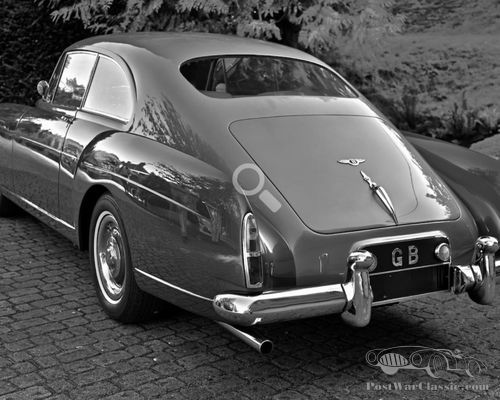
1957 Bentley S1 Fastback door H.J. Mulliner.
1957 Bentley S1 Fastback by H.J. Mulliner.Recent volledig gerestaureerd en bekroond exemplaar, in een staat die vrijwel gelijk is aan nieuw...
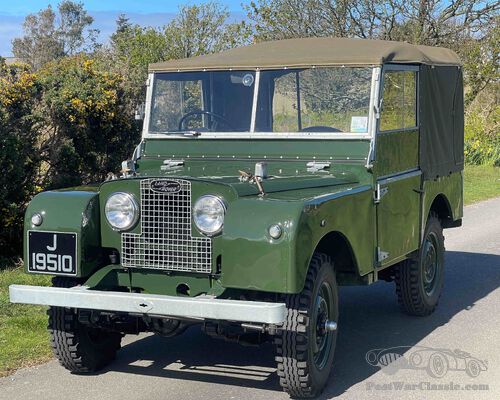
1952 Land Rover Series 1
Technische specificaties:Merk en model: Land Rover Series !Bouwjaar: 1952Kenteken: geregistreerd in ..
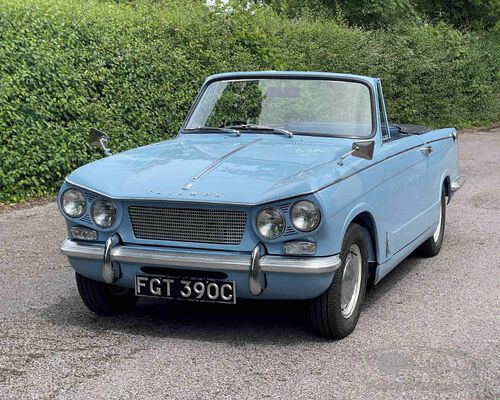
Triumph Vitesse 6 Convertible
Technische specificatiesMerk & model: Triumph Vitesse 6 ConvertibleBouwjaar: 1965Kenteken: Britse registratie