Het wereldwijde magazine en verkoopplatform voor liefhebbers van klassieke auto’s, door liefhebbers.
Het wereldwijde magazine en verkoopplatform voor liefhebbers van klassieke auto’s, door liefhebbers.


Maak een keuze
- Auto's
-
Merk >>
-
Bouwjaar >>
-
-
Categorie >>
- Motorfietsen
-
Bouwjaar >>
-
- Onderdelen
-
Automerk >>
-
Fabrikant >>
-
Categorie >>
-
Landen



De marktplaats: alle oldtimers te koop
Overzicht van gerelateerde advertenties 1949 Jaguar Mark V Saloon 2.5 Litre
-

1957 Jaguar Mk. VIII | Mercedes Benz Worlds Brooklands sale - November 2023 | Historics Auctioneers
The Jaguar Mk. VIII was introduced at the 1956 London Motor Show and shared its ten-foot wheelbase with its predecessor, the Jaguar Mk. VII, which outwardly it closely resembled. However, the interior fittings were more luxurious than those of the Mk. VII. Distinguishing visually between the models is facilitated by changes to the front grille, the..1957JaguarMk. VIIIVERKOCHTLocatie: Verenigd Koningkrijk -
1949 Vauxhall Wyvern L | Mercedes Benz Worlds Brooklands sale - November 2023 | Historics Auctioneers
We are delighted to offer this 1949 Vauxhall Wyvern L that has undergone the most extraordinary restoration to the highest standards. This Wyvern has been in its current ownership for approximately 22 years and around four years ago, a decision was made to restore the car to the standard that is presented today; a process that took nearly three yea..1949VauxhallWyvern LVERKOCHTLocatie: Verenigd Koningkrijk -
1969 Jaguar E-Type Series II Roadster | Mercedes Benz Worlds Brooklands sale - November 2023 | Historics Auctioneers
There is little doubt that the advent of Jaguar’s E-Type revolutionised the motoring world and sent the press into raptures, the penmanship that created such exquisite lines was truly gifted. The Museum of Modern Art recognised the significance of the Jaguar E-Type's design in 1996 by adding a blue roadster to its permanent design collection, one o..1969JaguarE-Type Series II RoadsterVERKOCHTLocatie: Verenigd Koningkrijk -
1959 Jaguar XK150 S 3.4-Litre Roadster | Geared Online | Auction ends 8 December 2023
Launched in 1958, the XK150 S represents the ultimate development of Jaguar’s legendary line of XK sports cars. In its original 3.4-litre form, the “S” model yielded significant performance dividends, with three SU carburetors, straight-port intake manifolds, and upgraded camshafts contributing 60 hp over the standard XK150. Equipped with Le Man..1959JaguarXK150 S 3.4-Litre RoadsterVERKOCHTLocatie: Verenigde Staten -
1956 Jaguar XK140 SE Roadster | Geared Online | Auction ends 8 December 2023
Jaguar’s XK140 added several meaningful developments to its predecessor, the XK120, which had stunned the public when it debuted in 1948. Clever repackaging increased interior space, while the technical specification gained rack and pinion steering and telescopic shock absorbers. Some of Jaguar’s most thrilling technical innovations, which contr..1956JaguarXK140 SE RoadsterVERKOCHTLocatie: Verenigde Staten -
1970 Jaguar E-Type Series II Fixedhead Coupé | Mercedes Benz Worlds Brooklands sale - November 2023 | Historics Auctioneers
Powered by the uprated 4.2 litre engine, compared to the 3.8 litre unit fitted to the previous model, the series II E-Type offers longer legs for those continental drivers as well as offering a more practical sports car experience. Those classic E-Type styling cues though, are still very much present with that most beautiful of bonnet lines extendi..1970JaguarE-Type Series II (Fixedhead Coupé)VERKOCHT -
1961 Jaguar E-Type Series I Roadster Flat-floor (3.8 litre) | Mercedes Benz Worlds Brooklands sale - November 2023 | Historics Auctioneers
Introduced in 3.8 litre form in 1961, the Jaguar E-Type caused a sensation when it appeared with instantly classic lines and 150mph top speed. While, inevitably, the car's stupendous straight-line performance and gorgeous looks grabbed the headlines, there was a lot more to the E-Type beneath the skin. The newcomer's design owed much to that of the..1961JaguarE-Type Series I Roadster Flat-floor (3.8 litre)VERKOCHT -
1967 Jaguar E-Type Series I 2+2 Coupé | Mercedes Benz Worlds Brooklands sale - November 2023 | Historics Auctioneers
Launched at the 1961 Geneva Motor Show, the Jaguar E-Type was nothing short of a revelation. With its heady blend of supercar performance, breathtaking styling and low price tag, the newcomer left rivals reeling and customers clamouring. Early sportscar racing success at the hands of Graham Hill and Roy Salvadori amongst others helped cement its re..1967JaguarE-Type Series I 2+2 CoupéVERKOCHT -
1973 Jaguar E-Type Series III Roadster | Mercedes Benz Worlds Brooklands sale - November 2023 | Historics Auctioneers
The E-Type Series III was introduced in 1971, with a new 5.3 litre, V12 engine, uprated brakes, and power steering as standard. Optionally, an automatic transmission, wire wheels and air conditioning were available. The brand new V12 engine produced 272bhp, had increased torque, and a 0-60mph time of less than seven seconds, which was phenomenal fo..1973JaguarE-Type Series III RoadsterVERKOCHT -
1959 Jaguar XK150 Drophead Coupé | Mercedes Benz Worlds Brooklands sale - November 2023 | Historics Auctioneers
Although having a family resemblance to the XK120 and XK140, the XK150 was radically modernised. A one piece windscreen replaced the split screen and the wing line no longer dropped as much over the doors. The bonnet was widened, opened down to the wings and on the roadster, the bulkhead was moved back four inches to make the bonnet longer. In the ..1959JaguarXK150 Drophead CoupéVERKOCHT


Uitgelicht
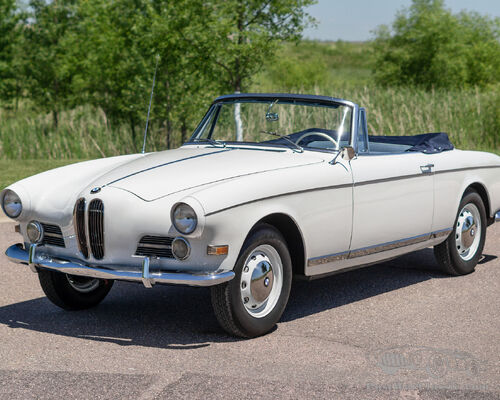
1957 BMW 503 Cabriolet (V8) – 1 van 13 gebouwd voor de Amerikaanse markt – #Matching exemplaar
1957 BMW 503 Cabriolet Serie 1Originele aluminium V8 # MatchingOriginele aluminium carrosserie met fabriekstempels1 v..
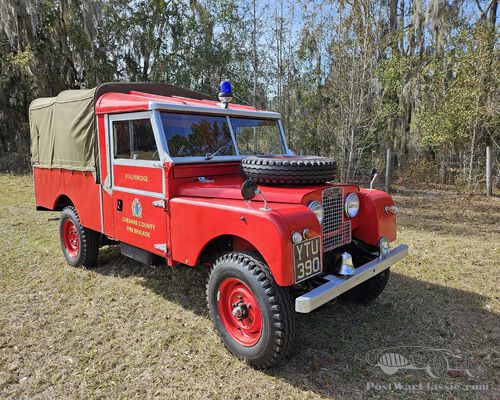
1957 Series 1 Land Rover Fire Engine + Coventry Climax Godiva Fire Pump
Betsy was used by Cheshire Fire Service (UK) from 1957 to 1975. She was based at Hazel Grove and Stalybridge Fire stations. She comes with an exten..