Het wereldwijde magazine en verkoopplatform voor liefhebbers van klassieke auto’s, door liefhebbers.
Het wereldwijde magazine en verkoopplatform voor liefhebbers van klassieke auto’s, door liefhebbers.





De marktplaats: alle oldtimers te koop
Overzicht van gerelateerde advertenties 1972 Ferrari 365 GTC4 by Pininfarina
-

1970 Triumph TR6 CP Fast Road | Historic Auctioneers | Farnborough International | 11th May 2024
The Triumph TR6 was manufactured for seven years, starting in 1969, and by the time production came to an end in July 1976, it was the best-seller of the TR range. The bodywork closely resembled that of the previous model, the Triumph TR5, but the front and rear were squared off and all TR6s featured inline six-cylinder engines. For the US market, .. -
1974 Jaguar E-Type Series III Roadster | Historic Auctioneers | Farnborough International | 11th May 2024
The Jaguar E-Type was ten years old and needed new life. History repeated itself and it was a huge success when Jaguar debuted its robust new engine in a sports car instead of the saloon for which it was designed. Despite its sports-car heritage, Jaguar depended on saloon vehicles for its survival and had developed its twelve-cylinder engine to pow.. -
1971 Porsche 911 ST Specification | Historic Auctioneers | Farnborough International | 11th May 2024
The original 911ST has an interesting history, probably more so due to its genuine competition lineage. During the era of early 911 production, Porsche were continuously developing their road cars for competition, and with great success. Keen to see customers using their cars in the same manner, they created a series of performance accessories that.. -
2013 Ferrari 458 Italia | Historic Auctioneers | Farnborough International | 11th May 2024
In the official announcement, the 458 was described as the successor to the F430 but arising from an entirely new design, incorporating technologies developed from the company's experience in Formula 1. The 458 is powered by a 4.5 litre V8 engine of the ‘Ferrari/Maserati’ F136 engine family. The engine also featured direct fuel injection, which is .. -
1973 Rolls-Royce Corniche Convertible | Historic Auctioneers | Farnborough International | 11th May 2024
Introduced in March of 1971, the Corniche was a revised version of the H J Mulliner, Park Ward-bodied two-door variants of the Rolls-Royce Silver Shadow and Bentley T-Series saloons, themselves notable as the Crewe factory's first unitary-construction cars. They featured the finest engineered technologies of the day, such as independent suspension,.. -
1984 Ferrari 512BBi | Historic Auctioneers | Farnborough International | 11th May 2024
With a top speed of 283kph, this Ferrari was truly one of the fastest sportscars on the market during the 1980s and combined with such advanced technology as air conditioning and central locking as standard, the overall package had it all. Launched during the 1981's Paris Salon, Ferrari's 512i Berlinetta Boxer most notably marked the arrival of fue.. -
2005 Ferrari 612 Scaglietti | Historic Auctioneers | Farnborough International | 11th May 2024
The Scaglietti 2+2 Coupé was penned by Frank Stephenson under Ken Okuyama at Pininfarina, and it is said that the design, especially the strident side scallops and headlights, were a nod to the coachbuilt 1954 375 MM that film director, Roberto Rossellini, had commissioned for his wife Ingrid Bergman. The newcomer replaced the outgoing 456 but, bei.. -
1972 Ferrari Dino 246GT | Historic Auctioneers | Farnborough International | 11th May 2024
The Dino, named in honour of Enzo Ferrari’s son, was a brand for V6 engined Ferraris and the project that Alfredo ‘Dino’ Ferrari worked on before he died tragically of muscular dystrophy at just 24 years old. In order to homologate Ferrari’s Formula Two entry in 1966, the FIA requested that 500 production cars were produced using the same V6 unit a.. -
1977 Jaguar Series II XJC V12 | Historic Auctioneers | Farnborough International | 11th May 2024
The XJ series of motorcars were the mainstay of Jaguar cars since 1968 and, in fact, was the last motorcar to have any input by Sir William Lyons, its founder. After the series I and II, a relatively short run of two-door XJ coupés with a pillarless hardtop body called the XJ-C were built between 1975 and 1978. The car was actually launched at the .. -
1974 Jensen Interceptor Convertible | Historic Auctioneers | Farnborough International | 11th May 2024
The Jensen Interceptor was a grand touring car produced between 1966 and 1976. One of the most coveted versions of this car was the 1974 Jensen Interceptor Convertible, which combined the sleek design and powerful engine of the Interceptor with the open-air experience of a convertible. Under the bonnet, the Jensen Interceptor Convertible featured a..


Uitgelicht

Rolls-Royce
Rolls-Royce Silver Wraightlinks gestuurd, automatic, stuurbekrachtigingkleur antraciet grijs, lopende auto op Nederlands kenteken
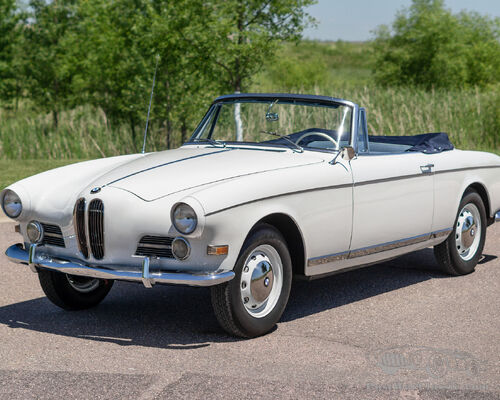
1957 BMW 503 Cabriolet (V8) – 1 van 13 gebouwd voor de Amerikaanse markt – #Matching exemplaar
1957 BMW 503 Cabriolet Serie 1Originele aluminium V8 # MatchingOriginele aluminium carrosserie met fabriekstempels1 v..