Het wereldwijde magazine en verkoopplatform voor liefhebbers van klassieke auto’s, door liefhebbers.
Het wereldwijde magazine en verkoopplatform voor liefhebbers van klassieke auto’s, door liefhebbers.





De marktplaats: alle oldtimers te koop
Overzicht van gerelateerde advertenties Mini 850
-

1973 Ferrari 365 GTB/4 Daytona Spider | Amelia Island Auctions | Gooding & Co | March 2-3, 2023
Debuted in Paris in 1968, the 365 GTB/4 succeeded the 275 GTB/4 as Ferrari’s new top-of-the-line, two-seat gran turismo. Almost immediately, it was unofficially known as the “Daytona” in honor of Ferrari’s podium sweep at the 24 Hours of Daytona in 1967, and it stands as the last front-engine, V-12 GT model designed before Fiat’s takeov.. -
1973 Alfa Romeo 1600 Junior Zagato | Amelia Island Auctions | Gooding & Co | March 2-3, 2023
Designed by Zagato’s Ercole Spada and debuted at the 1969 Torino Motor Show, the Junior Zagato satisfied Alfa Romeo’s desire for a more sophisticated and upscale alternative to the Giulia GT coupe. Initially powered by a 1,300 cc engine, the 1,600 cc derivative was launched for the 1972 model year, allowing use of the entire Giulia Spider floor .. -
1970 Citroën Méhari | Amelia Island Auctions | Gooding & Co | March 2-3, 2023
Named after a swift dromedary camel, Citroën’s Méhari was an elemental and lightweight recreational and utility vehicle, based on the chassis and mechanicals of the 2CV. In fact, the Méhari was quite similar in concept to BMC’s Mini-derived Mini Moke. In addition to the innovative chassis and suspension design of the 2CV, the Méhari featured a u.. -
1976 Porsche 930 | Amelia Island Auctions | Gooding & Co | March 2-3, 2023
Having established their reputation with lightweight, naturally aspirated, well-handling sports cars, the 930 marked a large departure from their original recipe for Porsche. Under its flared fenders and the iconic “whale tail” spoiler was a turbocharged flat-six, which produced nearly 250 bhp. Not meant for the faint of heart, the single KKK tu.. -
1976 Ferrari 308 GTB Vetroresina | Amelia Island Auctions | Gooding & Co | March 2-3, 2023
Introduced at the 1975 Paris Motor Show, the mid-engine, two-seater Ferrari 308 GTB featured a 2.9-liter DOHC V-8, five-speed transaxle, independent suspension, and four-wheel disc brakes. Bodywork was fabricated from fiberglass – vetroresina in Italian – until June 1977. This 1976 Ferrari 308 GTB is one of 712 Vetroresinas built and on.. -
1973 Alfa Romeo Montreal | Amelia Island Auctions | Gooding & Co | March 2-3, 2023
Introduced at the 1970 Geneva Motor Show, the Alfa Romeo Montreal was a sleek 2+2 front-engine, rear-wheel drive coupe designed by Marcello Gandini of Bertone. Derived from the exotic Tipo 33 Stradale, the Montreal’s 2.6-liter, quad-cam V-8 with Spica mechanical fuel injection and dry-sump lubrication was mated to a five-speed ZF manual gearbox... -
1974 Volkswagen Karmann Ghia Convertible | Amelia Island Auctions | Gooding & Co | March 2-3, 2023
Originally designed by Carrozzeria Ghia of Torino and built by Karmann of Osnabrück, Germany, the Karmann Ghia Coupe debuted at the 1955 Paris Motor Show where it found immediate popularity, and a convertible variant was introduced just two years later. Production continued with minimal changes until 1974, when it was replaced by the Golf-based.. -
1971 Ferrari 365 GTB/4 Daytona | Amelia Island Auctions | Gooding & Co | March 2-3, 2023
When Ferrari launched its brand-new 365 GTB/4 at the Paris Motor Show in 1968, the memory of Ferrari’s epic 1-2-3 win at the 24 Hours of Daytona the year before was still fresh in the mind of the automotive world. Hence, the new car in the stable was dubbed “Daytona” in honor of that historic event – a name commonly used by all but Ferrari, whic.. -
1975 Volkswagen Super Beetle | Amelia Island Auctions | Gooding & Co | March 2-3, 2023
Introduced in 1975, the “La Grande Bug” was a limited-edition Volkswagen Super Beetle which, like previous versions, benefited from decades of development in performance, comfort, and reliability. In addition to having a slightly wider and longer body, which provided more room for passengers and storage, Super Beetles featured an upgraded front .. -
1977 Land Rover Series III 88 | The Amelia Auction | Broad Arrow Auctions | March 3-4, 2023
Chassis No. 904.374.33 A What remaining a clear favorite among many off-road enthusiasts to this day, the charming Series I was first released by Land Rover in 1948 and remained in continuous production for nearly 40 years. Taking inspiration from the robust World War II era Jeeps, Land Rover would offer a sturdy box-welded frame and crucial..


Uitgelicht
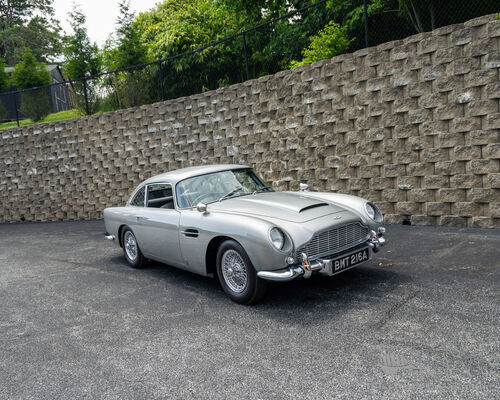
2020 Aston Martin DB5 Goldfinger Continuation
Wordt geveild door RM Sotheby's tijdens The Monterey Auction, 13–15 augustus 2026. Geschatte opbrengst: USD 1.000.000 – 1.500.000..
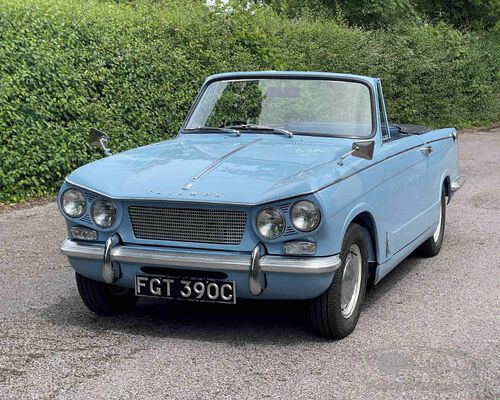
Triumph Vitesse 6 Convertible
Technische specificatiesMerk & model: Triumph Vitesse 6 ConvertibleBouwjaar: 1965Kenteken: Britse registratie
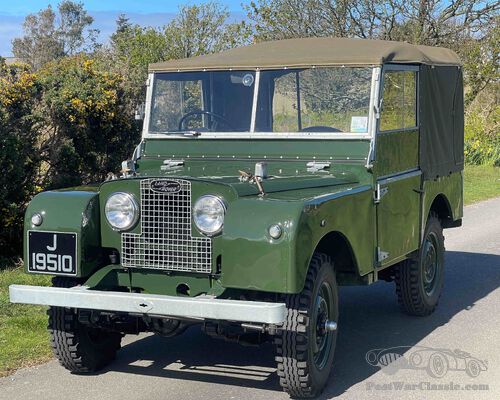
1952 Land Rover Series 1
Technische specificaties:Merk en model: Land Rover Series !Bouwjaar: 1952Kenteken: geregistreerd in ..