Het wereldwijde magazine en verkoopplatform voor liefhebbers van klassieke auto’s, door liefhebbers.
Het wereldwijde magazine en verkoopplatform voor liefhebbers van klassieke auto’s, door liefhebbers.





De marktplaats: alle oldtimers te koop
Overzicht van gerelateerde advertenties Mini 850
-

1978 Rolls-Royce Silver Shadow II | Mercedes-Benz World | Historics Auctioneers | 27th November 2021
The Silver Shadow broke new ground for the Crewe Company in a number of key areas, from the sophisticated fully independent suspension with an advanced self-levelling system to the four-wheel ventilated disc brakes. The only major components carried over from the Silver Cloud III was the excellent, all aluminium, 6.2 litre V8 and four-speed automat.. -
1970 Bentley T1 | Mercedes-Benz World | Historics Auctioneers | 27th November 2021
Predating Bentley’s 1980s resurgence, the T1 was produced in far fewer numbers than the equivalent Rolls-Royce Silver Shadow, the ratio being 11:1 in the Shadow’s favour, making the Bentley considerably rarer today. On the road, the T-Series afforded its owners the advantage of an eye-line higher than that of most other cars, giving its occupants a.. -
2009 Mini Cooper S JCW | Mercedes-Benz World | Historics Auctioneers | 27th November 2021
Introduced in 2001, the hatchback Mini was the first model of the new generation and back then was simply known as Mini. It was available in Cooper, Cooper S and One variations. In many European markets, the Mini One was powered by a 1.4 litre version but all other petrol powered Minis used the 1.6 litre version. The names Cooper and Cooper S, used.. -
1972 Mercedes-Benz 350SL | Mercedes-Benz World | Historics Auctioneers | 27th November 2021
This well-presented example is offered in burgundy metallic coachwork over a beige Tex interior and has been treated to much renovation work with Mercedes-Benz specialists, the cost of which totalling circa £16,000. The works consisted of an extensive brake overhaul, a major service including gearbox, differential and engine oils, a new belt, water.. -
1970 Mercedes-Benz 280 SL Pagoda | Mercedes-Benz World | Historics Auctioneers | 27th November 2021
The Mercedes-Benz 280 SL was introduced in December 1967 and continued in production till February 1971. An all new designed by Paul Bracq to replace the 190SL and 300SL Roaster. The 280 SL had a powerful 2.8 litre version of Mercedes inline-six and used Bosch fuel injection. To save on weight, the bonnet, doorskins, boot lid, and tonneau cover wer.. -
1978 Ferrari 308 GTB | Mercedes-Benz World | Historics Auctioneers | 27th November 2021
Officially introduced at the Paris Salon in October 1975, the 308 GTB’s styling was created by Pininfarina. The stunning two-seat coachwork was all new but incorporated all of the old magic by blending aspects of the Dino 206/246 with the later 365 GT4/BB. Reminiscent of the Boxer was the dihedral groove at bumper level splitting top and bottom, th.. -
1975 Jensen Interceptor Mk. III | Mercedes-Benz World | Historics Auctioneers | 27th November 2021
The Jensen Interceptor was launched in 1966 and the all steel bodyshell broke away from the company's traditional method of construction that used GRP (glass reinforced plastic). Designed by Carrozzeria Touring, the early cars were built by Vignale before production eventually was carried out at the Jensen works in West Bromwich. Power was delivere.. -
1971 Jaguar E-Type Series III 2+2 Coupé | Mercedes-Benz World | Historics Auctioneers | 27th November 2021
By the mid-1960s, the Jaguar E-Type was appealing to the man with a young family but who were restricted by the size of the current Jaguar E-Type Coupé and its open topped sibling. This prompted Jaguar to offer a third option in the form of a 2+2 Coupé. By adding nine inches to the wheelbase and two inches in height, it was then possible to fit a r.. -
1972 Ford Escort Mk. I 1300GT | Mercedes-Benz World | Historics Auctioneers | 27th November 2021
The Ford Escort was introduced in the United Kingdom at the end of 1967, making its show debut at the Brussels Motor Show in January 1968. The Escort was a commercial success in many parts of Western Europe, but nowhere more than in the UK, where it was consistently the national best seller. In June 1974, less than six years after the car's UK intr.. -
1970 Ford Cortina Mk. II Savage Estate | Mercedes-Benz World | Historics Auctioneers | 27th November 2021
The Cortina Savage was first produced by Race Proved Performance and Racing Equipment Limited in the mid-1960s and came in the form of the MK. II Ford Cortina. It was designed and produced by the 1959 British Saloon Car Champion, Jeff Uren. The most obvious feature of the later Cortina Savage is the optional fiberglass bonnet but this usually not s..


Uitgelicht
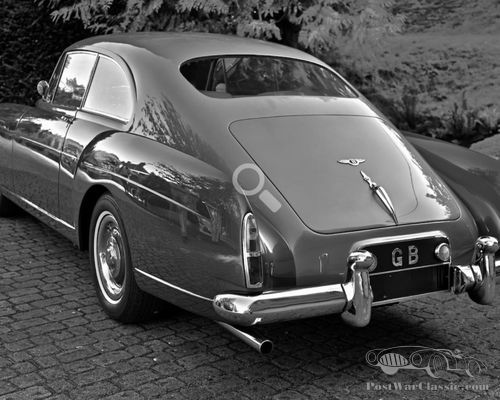
1957 Bentley S1 Fastback door H.J. Mulliner.
1957 Bentley S1 Fastback by H.J. Mulliner.Recent volledig gerestaureerd en bekroond exemplaar, in een staat die vrijwel gelijk is aan nieuw...
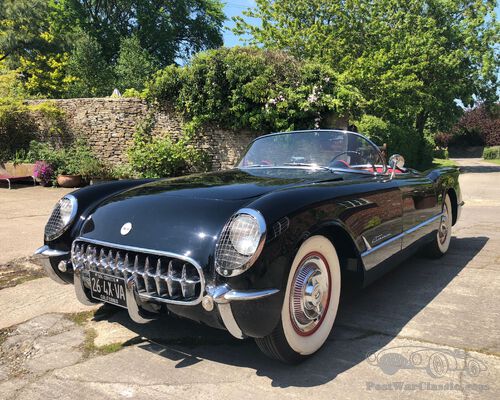
1954 Corvette C1 - SUPER RARE Black!!
Looking for her next lover, my classy 1954 Corvette C1. She's a beautiful sculpture. Never have i had so many adoring comments as when drivi..
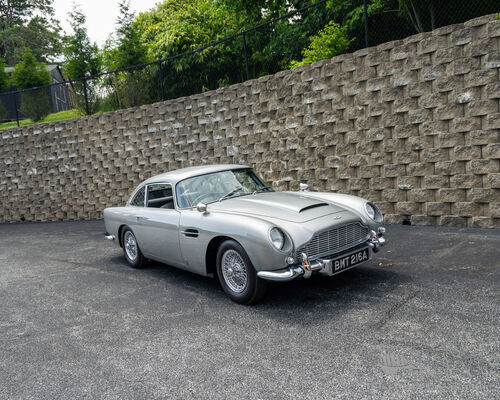
2020 Aston Martin DB5 Goldfinger Continuation
Wordt geveild door RM Sotheby's tijdens The Monterey Auction, 13–15 augustus 2026. Geschatte opbrengst: USD 1.000.000 – 1.500.000..