Het wereldwijde magazine en verkoopplatform voor liefhebbers van klassieke auto’s, door liefhebbers.
Het wereldwijde magazine en verkoopplatform voor liefhebbers van klassieke auto’s, door liefhebbers.





De marktplaats: alle oldtimers te koop
Overzicht van gerelateerde advertenties 2002 Jaguar X-TYPE 2.5 V6
-

1986 Ferrari Testarossa (Monospecchio) | Historics Auctioneers
Interested parties should note that this is a library image. Pictures of this vehicle will be added shortly.At the Paris Salon of 1984, Ferrari presented the successor to the legendary BB512 after nearly ten years of production. Called Testarossa, referring to the legendary Le Mans winning car, it is again the work of Pininfarina. The Testarossa is.. -
1983 Mercedes-Benz 380SL | Historics Auctioneers
Introduced in early 1971, this impressive two-seater sports car replaced the 280 SL. The body and chassis of the third generation SL was considerably heavier and longer than its predecessor but it still showed a resemblance. The standard transmission provided a top speed of 130mph and a very respectable 0-62mph in 8.8 seconds. As with the previous .. -
1980 Mitsubishi Sapporo | Historics Auctioneers
The Mitsubishi Sapporo coupé was in production from 1978 until 1984. These were very well equipped vehicles for the time. Standard equipment included four electric windows revealing a great looking pillarless coupé, power steering, alloy wheels and a radio cassette. Compare that to the UK based manufacturers at the time and it is easy to see how th.. -
1966 Jaguar S-Type (3.4 litre) | Historics Auctioneers
Produced from 1963 to 1968, the Jaguar S-Type was technically a more sophisticated development of the Jaguar Mk. II, offering buyers a more luxurious alternative. It was available with either 3.4 or 3.8 litre XK engines and featured longer rear bodywork among other styling and interior changes. Despite its extra weight, the S-Type's independent rea.. -
1990 Mini Mayfair | Historics Auctioneers
The Mini was a made by the British Motor Corporation (BMC) and its successors from 1959 until 2000. The original is considered a British icon of the 1960’s, and its space-saving front-wheel drive layout which allowed 80% of the car's floorpan to be used for passengers and luggage, influenced a generation of car makers. In 1999 the Mini was voted th.. -
1958 Jaguar Mk. I (3.4 litre) | Historics Auctioneers
Launched in 1955, the Mk. I extended Jaguar's domination of the high-performance car market in Britain, slotting neatly into the Coventry firm's range alongside the big Mk. VII M saloon and the XK140 sports car. The medium size newcomer broke new ground for Jaguar, being its first model to employ unitary construction of the chassis/body. Jaguar's e.. -
1972 Jaguar E-Type Series III Roadster | Historics Auctioneers
In March 2008, the Jaguar E-Type ranked first in the Daily Telegraph's list of the '100 most beautiful cars' of all time. It was initially designed and shown to the public as a grand tourer in two-seater coupé form and as convertible. The model was made in three distinct versions which are now generally referred to as 'Series I', 'Series II' and 'S.. -
1960 Jaguar Mk. II (3.8 litre) | Historics Auctioneers
Built between 1959 and 1967 the Jaguar Mk. II is a medium sized saloon car constructed in Coventry as the successor to the Jaguar 2.4 litre and 3.4 litre models manufactured between 1957 and 1959. These retrospectively became known as the Jaguar Mk. I following the release of the Mk. II in 1959. Adhering to Sir William Lyons' maxim of ‘grace, pace .. -
1959 Jaguar XK150 Drophead Coupé | Historics Auctioneers
Despite having a family resemblance to the XK120 and XK140, the XK150 was radically modernised. A one-piece windscreen replaced the split screen and the wing line no longer dropped as much over the doors. The bonnet was widened, opened down to the wings and on the roadster, the bulkhead was moved back four inches to make the bonnet longer. In the i.. -
1970 Jaguar E-Type Series II Coupé | Historics Auctioneers
From its launch in 1961 to the end of its production in 1975, the Jaguar E-Type went from design revelation to motoring icon in a generation. Based on Jaguar’s three time Le Mans winning D-Type and known internationally for its beautiful sleek lines and a top speed of 150mph, this revolutionary car had three significant series changes during its 14..


Uitgelicht
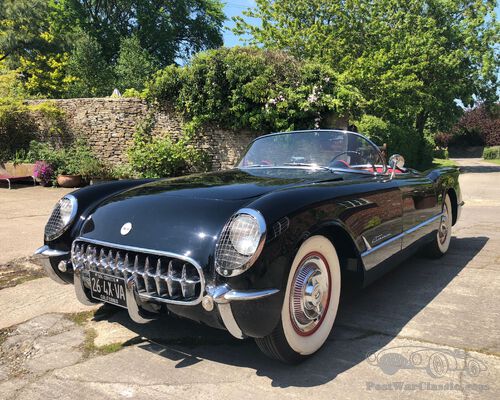
1954 Corvette C1 - SUPER RARE Black!!
Looking for her next lover, my classy 1954 Corvette C1. She's a beautiful sculpture. Never have i had so many adoring comments as when drivi..
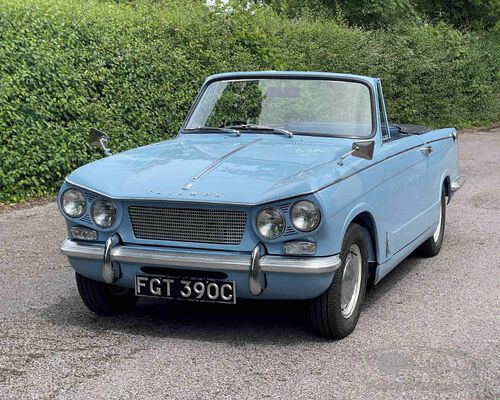
Triumph Vitesse 6 Convertible
Technische specificatiesMerk & model: Triumph Vitesse 6 ConvertibleBouwjaar: 1965Kenteken: Britse registratie
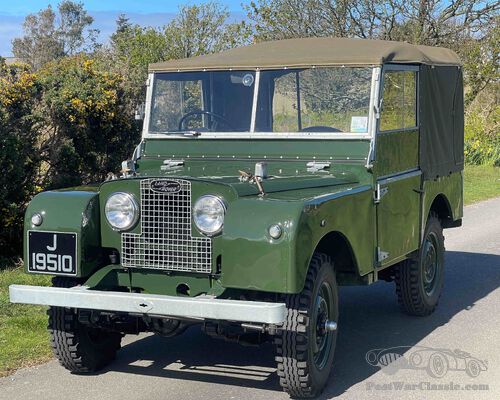
1952 Land Rover Series 1
Technische specificaties:Merk en model: Land Rover Series !Bouwjaar: 1952Kenteken: geregistreerd in ..