Het wereldwijde magazine en verkoopplatform voor liefhebbers van klassieke auto’s, door liefhebbers.
Het wereldwijde magazine en verkoopplatform voor liefhebbers van klassieke auto’s, door liefhebbers.





De marktplaats: alle oldtimers te koop
Overzicht van gerelateerde advertenties 1972 Citroen DS 23 PALLAS
-

1973 Porsche 911 2.4 S | Amelia Island Auction | Gooding & Company | March 1, 2024
In 1972, Porsche introduced what has come to be regarded as one of its finest variations on the classic 911 platform: the 2.4 S. It featured a 190 hp, fuel-injected flat-six engine, improved type 915 transaxle, and myriad refinements that made the magnificently engineered sports car a well-rounded performer. Just 1,430 S coupes were completed fo.. -
1970 Mercedes-Benz 280 SL | Amelia Island Auction | Gooding & Company | March 1, 2024
As the successor to the legendary 300 SL series built from 1954 to 1962, the W113 SL had enormous shoes to fill. The German automaker shifted the focus of the SL to be more of a volume seller, and the Paul Bracq-designed roadster was hailed as the next great Mercedes-Benz. In addition to having a fuel-injected, inline six-cylinder engin.. -
1965 Citroën DS19 Majesty | Amelia Island Auction | Gooding & Company | March 1, 2024
As early as 1958, Henri Chapron began purchasing complete DS models directly from Citroën, as required, to create special coachwork for them. One variant, the Majesty, featured a higher and more angular roofline than the factory DS, similar to the Concorde, providing increased headroom for the rear passengers and greater interior space. Its purp.. -
1963 Citroën DS19 Concorde | Amelia Island Auction | Gooding & Company | March 1, 2024
In 1955, Citroën introduced the revolutionary DS19 sedan. Despite new coachbuilt cars being few and far between at that time, Henri Chapron made body modifications to a DS19 in 1958, without the endorsement of Citroën. Chapron’s name was synonymous with exquisite coachwork of French marques including Delahaye, Talbot-Lago, and Delage throughout .. -
1963 Citroën DS19 Le Dandy | Amelia Island Auction | Gooding & Company | March 1, 2024
Henri Chapron was a prominent Parisian coachbuilder of Art Deco-style automobiles in the 1930s. Following WWII, the need for such coachwork was diminishing. In 1958, with the introduction of the new Citroën DS, Chapron decided to create hand-built custom bodies without the support of Citroën. Chapron was initially required to purchase complete c.. -
1966 Citroën DS21 Le Leman | Amelia Island Auction | Gooding & Company | March 1, 2024
Following the revolutionary DS19 introduced at the Paris Motor Show in October 1955, Citroën created a successor to the model with the DS21. The 21 improved on the 19 with an increase in power from 75 to 125 hp. Both featured hydropneumatic suspension, allowing the vehicle to operate while balanced on three wheels if necessary. Until the 1950s, .. -
1973 Porsche 911 2.4 T | Amelia Island Auction | Gooding & Company | March 1, 2024
This stunning US-delivery 911 2.4 T was factory-specified in the rare, vibrant color of Dalmatian Blue and nicely optioned, including the Comfort Package and front and rear stabilizer bars. After time in the Pacific Northwest, the Porsche was acquired by enthusiast Charles Coviello of Connecticut. In 2010, Coviello had a restoration performed by.. -
1979 Ducati 900 Super Sport | Amelia Island Auction | Gooding & Company | March 1, 2024
Shortly before Mike Hailwood’s famous 1978 victory at the Isle of Man TT on a Ducati 900 NCR, the firm introduced a black and gold version of its flagship high-performance 900 Super Sport for the UK. The bike’s stunning good looks stirred huge demand and soon Ducati released the model for worldwide distribution to great acclaim. This sp.. -
1977 Toyota FJ40 Land Cruiser | Amelia Island Auction | Gooding & Company | March 1, 2024
The Toyota FJ was Japan’s answer to the British Land Rover and American Jeep beginning in the early 1950s. With its small chassis and virtually indestructible engine, transmission, and suspension, the FJ quickly established itself as a go-to vehicle to tackle daunting terrain. With the model having origins as a mobility vehicle for Japan’s Natio.. -
1976 GAZ-24 Volga | Amelia Island Auction | Gooding & Company | March 1, 2024
Andrey Lipgart was a Russian automotive engineer who received formal training from the Ford Motor Company in the US. During his tenure at Ford, Mr. Lipgart carefully studied contemporary American automotive designs and assembly-line production. Following his return to the Soviet Union, he was named chief constructor at the Gorky Automobile Plant..


Uitgelicht
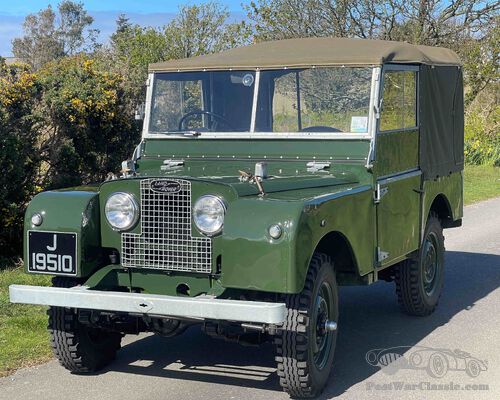
1952 Land Rover Series 1
Technische specificaties:Merk en model: Land Rover Series !Bouwjaar: 1952Kenteken: geregistreerd in ..
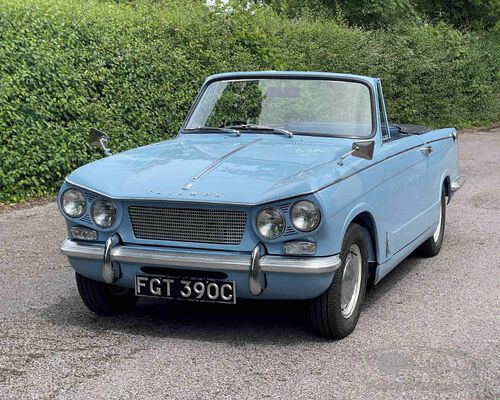
Triumph Vitesse 6 Convertible
Technische specificatiesMerk & model: Triumph Vitesse 6 ConvertibleBouwjaar: 1965Kenteken: Britse registratie
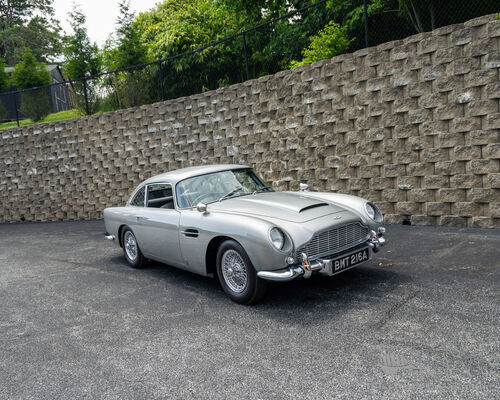
2020 Aston Martin DB5 Goldfinger Continuation
Wordt geveild door RM Sotheby's tijdens The Monterey Auction, 13–15 augustus 2026. Geschatte opbrengst: USD 1.000.000 – 1.500.000..