Het wereldwijde magazine en verkoopplatform voor liefhebbers van klassieke auto’s, door liefhebbers.
Het wereldwijde magazine en verkoopplatform voor liefhebbers van klassieke auto’s, door liefhebbers.





De marktplaats: alle oldtimers te koop
Overzicht van gerelateerde advertenties 1976 Alfa Romeo Sports Coupé by Autotecnica del Lario | RM Sotheby's | The Woodcote Park Auction
-

1968 Mercedes-Benz 280 SL Pagoda | Mercedes Benz Worlds Brooklands sale - November 2023 | Historics Auctioneers
The Mercedes-Benz 280 SL was introduced in December 1967 and continued in production until February 1971. An all-new design by Paul Bracq to replace the 190 SL and 300 SL Roaster. The 280 SL had a powerful 2.8 litre version of Mercedes inline-six and used Bosch fuel injection. To save on weight the bonnet, boot lid and tonneau cover were all compos.. -
1962 Mercedes-Benz 300 SE | Mercedes Benz Worlds Brooklands sale - November 2023 | Historics Auctioneers
The Mercedes-Benz 300 SE Convertible was a prestigious model that was produced in the early 1960s. It was part of the Mercedes-Benz W112 series, which was manufactured between 1962 and 1967. The 300SE was one of the high-end models of the W112 series, known for its luxurious features and advanced technology for its time. This model was equipped wit.. -
1990 Alfa Romeo 164 3.0 | Mercedes Benz Worlds Brooklands sale - November 2023 | Historics Auctioneers
The Alfa Romeo 164's launch represented the beginning of the renaissance of its maker. It was a member of the Type Four project, which resulted in four cars from Alfa Romeo, Lancia, Fiat and Saab, all sharing the same floorpan. Of all the Type Fours, the Pininfarina styled Alfa 164 was by far the prettiest. The glorious Busso 3.0 litre V6 was used .. -
1969 Ford Escort Mk. I Twin Cam Evocation | Mercedes Benz Worlds Brooklands sale - November 2023 | Historics Auctioneers
The Ford Escort was introduced in the United Kingdom at the end of 1967, making its show debut at the Brussels Motor Show in January 1968. The Escort was a commercial success in many parts of Western Europe, but nowhere more than in the UK, where it was the national best seller of the 1960’s. In June 1974, less than six years after the car's UK int.. -
1961 Jaguar E-Type Series I Roadster Flat-floor (3.8 litre) | Mercedes Benz Worlds Brooklands sale - November 2023 | Historics Auctioneers
Introduced in 3.8 litre form in 1961, the Jaguar E-Type caused a sensation when it appeared with instantly classic lines and 150mph top speed. While, inevitably, the car's stupendous straight-line performance and gorgeous looks grabbed the headlines, there was a lot more to the E-Type beneath the skin. The newcomer's design owed much to that of the.. -
1967 Jaguar E-Type Series I 2+2 Coupé | Mercedes Benz Worlds Brooklands sale - November 2023 | Historics Auctioneers
Launched at the 1961 Geneva Motor Show, the Jaguar E-Type was nothing short of a revelation. With its heady blend of supercar performance, breathtaking styling and low price tag, the newcomer left rivals reeling and customers clamouring. Early sportscar racing success at the hands of Graham Hill and Roy Salvadori amongst others helped cement its re.. -
1965 Ford Lotus Cortina Mk. I | Mercedes Benz Worlds Brooklands sale - November 2023 | Historics Auctioneers
There are few road and racing cars more instantly recognised than a Lotus Cortina, with its green arrow pointing its way so clearly towards success. Using Ford's eponymous two-door saloon and Colin Chapman's fabulous twin-cam engine, the marriage was a match made in heaven. Chapman commissioned Harry Mundy, of Coventry Climax fame, to come-up with .. -
1964 Buick Wildcat | Mercedes Benz Worlds Brooklands sale - November 2023 | Historics Auctioneers
As automobile designers in the USA moved away from the excesses of the 1950s, the 1960s saw a new maturity in design that produced some of the best-looking cars in the history of the industry. Gone were the excessively chromed, bloated and finned bodies; in their place appeared sleek and low-slung machines that emphasised power, speed, comfort and .. -
1965 Mercedes-Benz 230 SL Pagoda | Mercedes Benz Worlds Brooklands sale - November 2023 | Historics Auctioneers
In 1960, executive director Fritz Nallinger proposed to develop a completely new SL design, based on technology from the W112. This led to the W113 platform, with an improved fuel-injected 2.3 litre M127 inline six-cylinder engine. The Mercedes-Benz W113 roadsters, designed by Paul Bracq, were produced from 1963 through to 1971. They were known as .. -
1963 Volkswagen Type 2 (T1) Splitscreen Camper | Mercedes Benz Worlds Brooklands sale - November 2023 | Historics Auctioneers
The Volkswagen Type 2 was introduced in 1950 as a multi-variant utility vehicle, known as the Transporter, Kombi or Microbus (depending on body type), and was devised as an evolution of the Volkswagen Type 1, the original Beetle. The first generation of these versatile vehicles (named the T1) was produced with a distinctive split windscreen from 19..


Uitgelicht
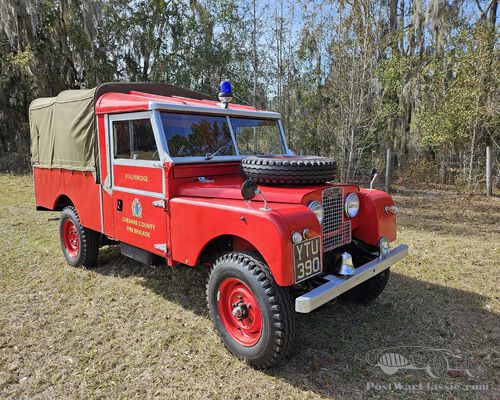
1957 Series 1 Land Rover Fire Engine + Coventry Climax Godiva Fire Pump
Betsy was used by Cheshire Fire Service (UK) from 1957 to 1975. She was based at Hazel Grove and Stalybridge Fire stations. She comes with an exten..
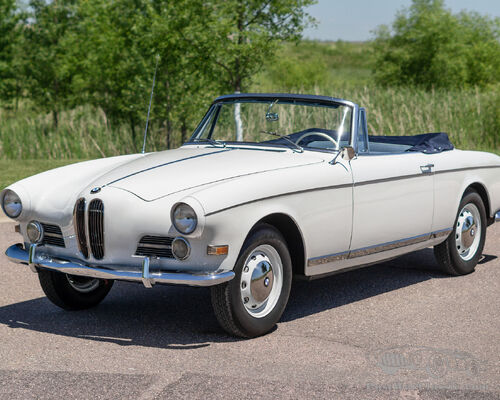
1957 BMW 503 Cabriolet (V8) – 1 van 13 gebouwd voor de Amerikaanse markt – #Matching exemplaar
1957 BMW 503 Cabriolet Serie 1Originele aluminium V8 # MatchingOriginele aluminium carrosserie met fabriekstempels1 v..