Het wereldwijde magazine en verkoopplatform voor liefhebbers van klassieke auto’s, door liefhebbers.
Het wereldwijde magazine en verkoopplatform voor liefhebbers van klassieke auto’s, door liefhebbers.





De marktplaats: alle oldtimers te koop
Overzicht van gerelateerde advertenties 1976 Alfa Romeo Sports Coupé by Autotecnica del Lario | RM Sotheby's | The Woodcote Park Auction
-

1965 Aston Martin DB5 Convertible | Pebble Beach Auctions | Gooding & Company
One of the most recognizable classic sports cars of all time is the DB5 – a car that represents the zenith of Aston Martin and benefits from the marque’s vast experience producing exceptional machines for road and track. Introduced to the world in 1963, the DB5 combined the sporting qualities of previous David Brown Aston Martins with a.. -
1968 Jaguar E-Type Series II 4.2-Litre Roadster | Pebble Beach Auctions | Gooding & Company
The Jaguar E-Type was the brainchild of Sir William Lyons, the automobile company’s founder, based on his Le Mans-winning D-Type race cars. Upon its introduction in 1961, the automotive press was astonished. With stunning bodywork, elegantly appointed interior, torquey inline six-cylinder engine, excellent independent suspension, and four-wheel .. -
1963 Shelby 260 Cobra | Pebble Beach Auctions | Gooding & Company
Of the many memorable sports cars built in the 1960s, few possess the enduring mystique of the Shelby Cobra. Envisioned by Le Mans-winning driver Carroll Shelby and developed by his team of talented engineers, the Cobra successfully combined the best qualities of European competition machinery and Southern California hot rods, creating a truly d.. -
1969 Ford Mustang Boss 429 | Pebble Beach Auctions | Gooding & Company
In the late 1960s, Ford needed a new engine to be competitive in NASCAR against Chrysler’s mighty 426 Hemi. Ford engineers answered the call with the now-legendary Boss 429 V-8 – featuring 11:1 compression, four-bolt mains, high-rise intake, 735 cfm Holley carburetor, and massive aluminum semi-hemispheric cylinder heads. To qualify for NASCAR co.. -
1963 Mercedes-Benz 230 SL | Pebble Beach Auctions | Gooding & Company
Internally designated “W113,” the 230 SL ushered in a new era of Sport-Leicht motoring for Mercedes-Benz customers with a modern, mid-century design and updated engineering to match. It featured a new 2.3-liter inline-six utilizing mechanical fuel injection – highly advanced for the time. The new Paul Bracq- designed sports car was a worthy and .. -
1967 Porsche 911 2.0 S | Pebble Beach Auctions | Gooding & Company
For the 1967 model year, Porsche offered a higher-performing variant of the original, short-wheelbase 911. The 911 S – for “Super” – offered performance enhancements over the standard model including a 160 hp air-cooled flat-six engine, four-wheel ventilated disc brakes, KONI shock absorbers, a stiffer front anti-sway bar, an anti-sway bar added.. -
1969 Toyota FJ40 Land Cruiser | Pebble Beach Auctions | Gooding & Company
The Toyota FJ40 has become one of the most iconic and sought-after off-road vehicles of all time, but its humble origins date to 1951, when it was developed for Japan’s National Police Reserve. Through almost seven decades, Toyota as has sold more than ten million Land Cruisers, setting the benchmark for durability and off-road performance. .. -
1961 Bentley S2 Continental Two-Door Saloon | Pebble Beach Auctions | Gooding & Company
When introduced in 1959, the S2 Continental represented the ultimate in British motoring – the latest ultra-exclusive, high-performance model from Bentley. Befitting its elite nature, the S2 Continental was available in an array of body styles from England’s premier coachbuilders. H.J. Mulliner maintained its reputation as the coachbuilder of ch.. -
1967 Jaguar E-Type Series I 4.2-Litre Fixed Head Coupe | Pebble Beach Auctions | Gooding & Company
The Jaguar E-Type was unveiled at the Geneva Motor Show in March 1961, but the guest of honor nearly missed its own debut. The Jaguar Fixed Head Coupe, destined for the motor show, was running late when leaving for Geneva, due to the enthusiastic response from the British press, who were offered an advanced preview back home in the UK. Jaguar’s .. -
1965 Land Rover 109 Series IIA Station Wagon | Pebble Beach Auctions | Gooding & Company
Introduced in 1948 in the footsteps of the American Jeep, the Land Rover has become an integral part of British postwar history. Built amid postwar steel shortages, early Land Rover bodies were constructed using aluminum alloy, which made them both lightweight and impervious to rust. A decade later, a more advanced and restyled Series II was int..


Uitgelicht
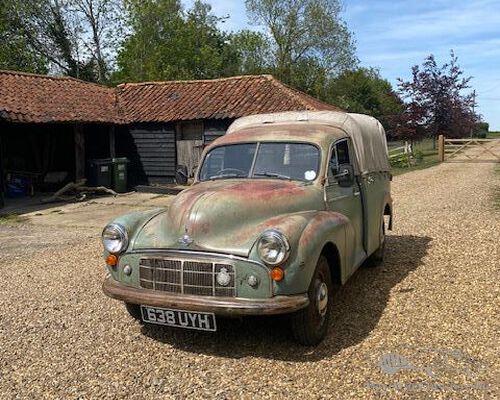
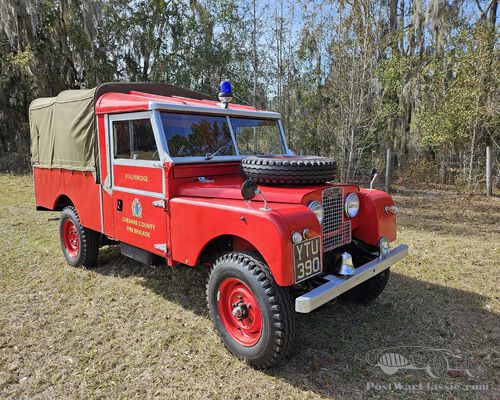
1957 Series 1 Land Rover Fire Engine + Coventry Climax Godiva Fire Pump
Betsy was used by Cheshire Fire Service (UK) from 1957 to 1975. She was based at Hazel Grove and Stalybridge Fire stations. She comes with an exten..
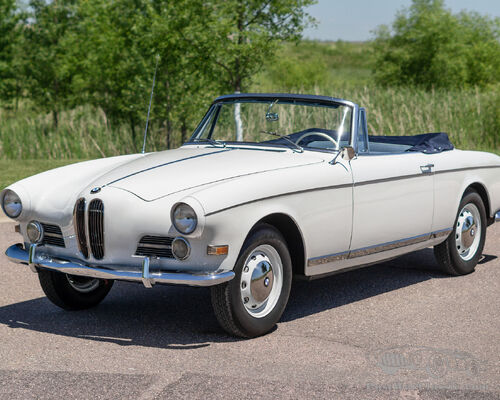
1957 BMW 503 Cabriolet (V8) – 1 van 13 gebouwd voor de Amerikaanse markt – #Matching exemplaar
1957 BMW 503 Cabriolet Serie 1Originele aluminium V8 # MatchingOriginele aluminium carrosserie met fabriekstempels1 v..