Het wereldwijde magazine en verkoopplatform voor liefhebbers van klassieke auto’s, door liefhebbers.
Het wereldwijde magazine en verkoopplatform voor liefhebbers van klassieke auto’s, door liefhebbers.





De marktplaats: alle oldtimers te koop
Overzicht van gerelateerde advertenties 1976 Jeep COMANDO
-

1972 Alfa Romeo Giulia 1600 Super | Ascot Racecourse Sale - 8 April 2023 | Historics Auctioneers
The first Giulia 105 series of motor cars, the Giulia Ti, was introduced to the motoring press at Monza on the 27th June 1962 in Berlina (saloon) form. Driven by the classic Alfa twin cam, engine capacity was increased from its predecessor, the Giulietta, from 1290cc to 1570cc and produced 92bhp in the new guise. The new car also included a five-sp.. -
1973 Alfa Romeo 2000 GT Veloce | Ascot Racecourse Sale - 8 April 2023 | Historics Auctioneers
The Giulia 105 Series Coupé was first shown to the motoring press on 9th September 1963, at the new Arese works in Milan and was mechanically based on the TI saloon (Berlina). Known as the Sprint GT, later versions were introduced that included the GT Veloce and 1750 GTV. June 1971 saw the replacement of the 1750 GTV with the 2000 GTV, the new mode.. -
1970 Lotus Europa | Ascot Racecourse Sale - 8 April 2023 | Historics Auctioneers
The Lotus Europa used Lotus founder Colin Chapman's minimalist steel backbone chassis that was first used in the Elan, while also relying on its fibreglass moulded body for structural strength, and was based on a prototype built to compete for Henry Ford II's contract to build a Le Mans racing car in the early 1960’s. The four-wheel independent sus.. -
1970 Volkswagen Beetle Convertible by Karmann | Ascot Racecourse Sale - 8 April 2023 | Historics Auctioneers
In 1948, Wilhelm Karmann bought a standard Beetle and converted it into a four-seater convertible. After successfully presenting it at Volkswagen in Wolfsburg, Karmann began production of the Volkswagen Beetle Cabriolet in 1949. After a number of stylistic and technical alterations made to it, the last of 331,847 cabriolets came off the conveyor be.. -
1974 Rolls-Royce Silver Shadow | Ascot Racecourse Sale - 8 April 2023 | Historics Auctioneers
The Silver Shadow was a luxury saloon car built from 1965 until 1980, it was the first Rolls-Royce to be constructed using a monocoque chassis and, to date, has the largest production volume of any Rolls-Royce. The original Shadow was slightly narrower and shorter than the Silver Cloud, which it replaced, but managed to offer increased passenger an.. -
1978 Jaguar SS100 by Suffolk | Ascot Racecourse Sale - 8 April 2023 | Historics Auctioneers
Regarded as one of the rarest and most elegant of pre-war designs, the Jaguar SS100 was entitled to reflect its ability to reach 100mph and the model’s combination of style and performance undoubtedly set the course for the company’s future successes. With a total of just 314 original examples produced between 1936 and 1939, the SS100 is also one o.. -
1973 MG B Roadster | Ascot Racecourse Sale - 8 April 2023 | Historics Auctioneers
Conceived in the late 1950s and launched in 1962, the MGB would turn out to be one of the most successful sports cars of all time. Attractively styled, cheap to run and easily maintained by the home mechanic, the 'B' carried on MG's traditional role of providing affordable, sports car motoring for the ordinary enthusiast. The MGB was mechanically s.. -
1970 Jaguar E-Type Series II 2+2 Coupé | Ascot Racecourse Sale - 8 April 2023 | Historics Auctioneers
The Jaguar E-Type Series II Coupé is a classic sports car that has a timeless look and is still highly sought-after. The E-Type was introduced in 1961 and the Series II Coupé was released in 1968. It features a sleek, aerodynamic design with a long bonnet and short rear end. The interior of the car is also very luxurious with leather seats. The pow.. -
1974 DAF Marathon 66 | Ascot Racecourse Sale - 8 April 2023 | Historics Auctioneers
The DAF Marathon 66 was produced by the Dutch car manufacturer, DAF, from 1972 to 1976. The DAF Marathon was designed by the legendary car designer Giovanni Michelotti. The DAF Marathon 66 was powered by either a reworked 1108cc, or 1289cc Renault engine. The DAF Marathon was praised for its excellent handling and roadholding. It featured an indepe.. -
1972 Aston Martin DBS V8 | Ascot Racecourse Sale - 8 April 2023 | Historics Auctioneers
The 1972 Aston Martin DBS V8 is one of the most iconic sports cars of all time. It was powered by a 5.3 litre V8 engine, which produced up to 310bhp and was equipped with either a five-speed manual, or three-speed automatic transmission. The DBS V8 featured a beautiful body that was crafted from aluminium and featured a long bonnet and short boot. ..


Uitgelicht
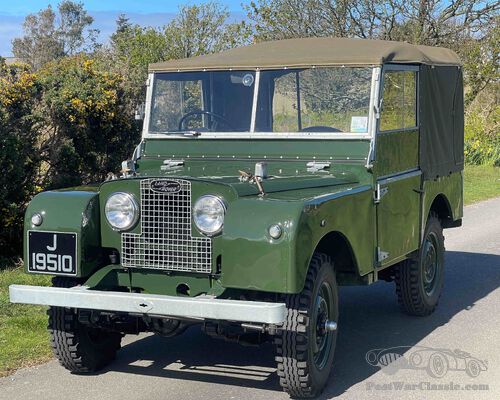
1952 Land Rover Series 1
Technische specificaties:Merk en model: Land Rover Series !Bouwjaar: 1952Kenteken: geregistreerd in ..
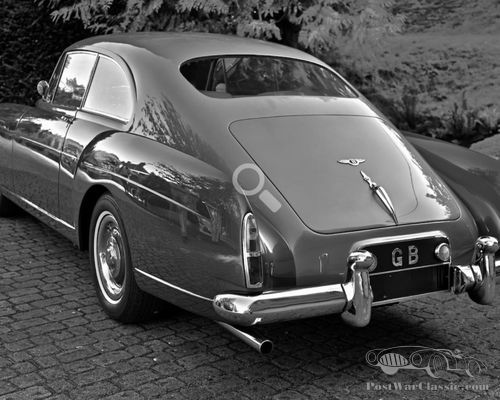
1957 Bentley S1 Fastback door H.J. Mulliner.
1957 Bentley S1 Fastback by H.J. Mulliner.Recent volledig gerestaureerd en bekroond exemplaar, in een staat die vrijwel gelijk is aan nieuw...
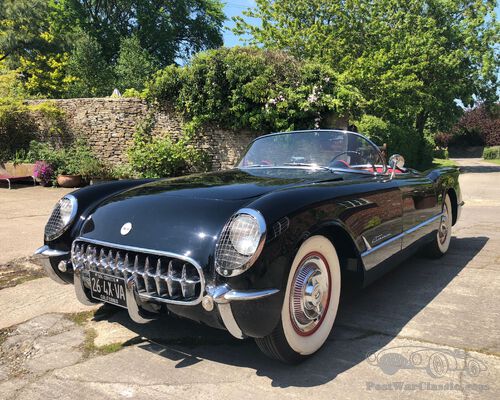
1954 Corvette C1 - SUPER RARE Black!!
Looking for her next lover, my classy 1954 Corvette C1. She's a beautiful sculpture. Never have i had so many adoring comments as when drivi..