Het wereldwijde magazine en verkoopplatform voor liefhebbers van klassieke auto’s, door liefhebbers.
Het wereldwijde magazine en verkoopplatform voor liefhebbers van klassieke auto’s, door liefhebbers.


Maak een keuze
- Auto's
-
Merk >>
-
Bouwjaar >>
-
-
Categorie >>
- Motorfietsen
-
Bouwjaar >>
-
-
Locatie >>
- Onderdelen
-
Automerk >>
-
Fabrikant >>
-
Categorie >>
-
Landen



De marktplaats: alle oldtimers te koop
Overzicht van gerelateerde advertenties BSA rigid D1 Comp Bantam
-

1969 BSA A65 Firebird Scrambler | Gooding & Company | Geared Online | Motorcycles
The Firebird Scrambler was BSA’s contribution to the growing interest in the US for enduro-look street scramblers, which possessed the style of a thoroughbred motocross machine but were more user friendly and designed for both on- and off-road use. The Firebird lineage can be traced back to the A65 Spitfire Scrambler and Hornet models of the ear..1969BSAA65 Firebird ScramblerVERKOCHT -
1970 BSA 650 Lightning | Gooding & Company | Geared Online | Motorcycles
Produced between 1965 and 1972, the BSA Lightning was a traditional British sports bike aimed at the lucrative American marketplace. Featuring a 654 cc parallel twin with twin Amal carburetors and high-lift camshafts, the Lightning was capable of over 100 mph flat out and possessed classic good looks. For the 1970 model year, BSA introduced seve..1970BSA650 LightningVERKOCHT -
1954 BMW R25/3 | Gooding & Company | Geared Online | Motorcycles
BMW's first new postwar model was a single-cylinder design, the 250 cc R24, which arrived in 1948, appearing very much like the prewar R23 but producing an additional 2 hp. It was superseded in 1950 by the R25, which featured plunger rear suspension. An improved R25/2 version was introduced during 1951 incorporating a stronger crankshaft and oth..1954BMWR25/3VERKOCHT -
1955 Ariel Square Four | Gooding & Company | Geared Online | Motorcycles
In 1930, the Ariel Square Four made its debut at the Olympia Motor Show. The bike featured an unusual four-cylinder engine that essentially consisted of two vertical twins sharing a common crankcase, cast as a monobloc design. The result was an ingeniously compact and practically vibration-free engine. 1953 saw the introduction of the Mark II mo..1955ArielSquare FourVERKOCHT -
1953 Norton Dominator 88 | Gooding & Company | Geared Online | Motorcycles
The first Norton road bike to feature the company’s legendary featherbed frame, the Model 88 Dominator, was a stylish, high-performance machine that debuted at the 1951 Earls Court Motorcycle Show. Initially known as the Dominator De Luxe, the Model 88 was developed to compete against Triumph’s Speed Twin and intended for export markets. The 88 ..1953NortonDominator 88VERKOCHT -
1970 BSA 441 Victor Special | Gooding & Company | Geared Online | Motorcycles
To celebrate Jeff Smith’s back-to-back Motocross World Championship victories, BSA introduced a race replica called the B44 Victor GP at the 1965 Earls Court Motorcycle Show. This model featured a frame derived from the BSA works racers and was powered by a 34 hp “round fin” engine. The following year, BSA launched a road-legal variant of the Vi..1970BSA441 Victor SpecialVERKOCHT -
1959 Honda Benly C92 | Gooding & Company | Geared Online | Motorcycles
Honda’s entry into the US market was well calculated, and two models were introduced for the 1959 model year – the 50 cc step-through Cub and the 124 cc Benly CA92. With the name loosely translating to “handy” in Japanese, this Benly model was meant to show the company’s durable and utilitarian designs as well as their ability to provide reliabl..1959HondaBenly C92VERKOCHT -
1958 Honda Benly JC-58 | Gooding & Company | Geared Online | Motorcycles
Soichiro Honda sought to give the Japanese people options for inexpensive, efficient transportation following WWII, and started offering Honda motorcycles in 1949. While their initial offerings were powered by two-stroke engines, four-strokes soon became the norm, and in 1953 Honda began production of the Benly, the first model that they also us..1958HondaBenly JC-58VERKOCHT -
1957 Honda Dream ME-250 | Gooding & Company | Geared Online | Motorcycles
The E-series Dream is widely regarded as the motorcycle that put Honda on the map as one of the world’s premier manufacturers. These pioneering models featured the brand’s first overhead-cam engines, a design that would become a hallmark of their incredibly successful models through the 1960s and 1970s. The significance of the Dream to the compa..1957HondaDream ME-250VERKOCHT -
1967 BSA A65 Lightning | Gooding & Company | Geared Online | Motorcycles
Produced between 1965 and 1972, the BSA Lightning was a traditional British sports bike aimed at the lucrative American marketplace. Featuring a 654 cc parallel twin with twin Amal carburetors and high-lift camshafts, the A65 Lightning was capable of over 100 mph flat out and was just as exciting to look at. The enduring appeal of this model was..1967BSAA65 LightningVERKOCHT


Uitgelicht

Rolls-Royce
Rolls-Royce Silver Wraightlinks gestuurd, automatic, stuurbekrachtigingkleur antraciet grijs, lopende auto op Nederlands kenteken
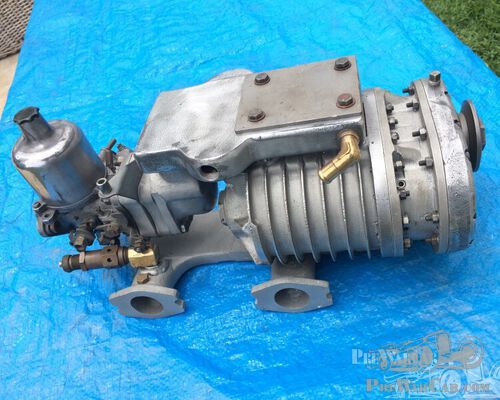
Blower / Compressor / Supercharger - Godfrey Marshall - A Series BMC Engine
SuperchargerA Godfrey Marshall cabin blower Type Mk22 converted to vehicle use by Barry Ekins of Sydney NSW. Ekins created kits for many popula..

BMW 502 V8 3,2L (Barockengel)
6-persoons touring sedan, beroemd uit de Duitse televisieserie "Isar 12"Productieperiode: 1955 – 1959, 2.517 exemplarenV-motor, 8 cil..