Het wereldwijde magazine en verkoopplatform voor liefhebbers van klassieke auto’s, door liefhebbers.
Het wereldwijde magazine en verkoopplatform voor liefhebbers van klassieke auto’s, door liefhebbers.





De marktplaats: alle oldtimers te koop
Overzicht van gerelateerde advertenties 1976 Ferrari 308 GTB 'Vetroresina' by Scaglietti | RM Sotheby's | The Monterey Auction
-

1979 Rolls-Royce Corniche | Historics Auctioneers
The Corniche was Rolls-Royce's coupé and convertible version of the Silver Shadow produced between 1971 and 1996. The Corniche was named 'Silver Shadow Mulliner Park Ward two door fixed head coupé' before 1971 when the Corniche name was applied. The exterior design was by John Polwhele Blatchley. The independent coach maker James Young had already .. -
1971 Rolls-Royce Corniche Convertible | Historics Auctioneers
Rolls-Royce Motors formed Mulliner Park Ward by the 1961 merger of two Rolls-Royce subsidiaries: Park Ward of Willesden, London, a Rolls-Royce subsidiary since 1939 and H. J. Mulliner & Co. of Chiswick, a Rolls-Royce subsidiary since 1959. Mulliner Park Ward continues to operate as the vehicle customisation division of Bentley Motors Limited, t.. -
1973 Jaguar E-Type Series III Roadster | Historics Auctioneers
The E-Type would be one of the last great sports cars developed directly from a successful competition ancestor. Just as in the D-Type, a monocoque tub formed the main body/chassis structure for the E-Type while a tubular space frame extended forwards to support the engine. As the E-Type evolved so did customers needs, Jaguar had developed the twel.. -
1973 Jaguar E-Type Series III Roadster | Historics Auctioneers
The E-Type Series III was introduced in 1971, with a new 5.3 litre, V12 engine, uprated brakes and standard power steering. Optionally, an automatic transmission, wire wheels and air conditioning were available. The brand new V12 engine came with four Zenith carburettors and was claimed to produce 272bhp, more torque, and a 0-60mph acceleration of .. -
1972 Mercedes-Benz 280 SE Coupé (3.5 Litre) | Historics Auctioneers
In the summer of 1965, Mercedes-Benz launched its new replacements for both W 111 and W 112 saloons, the W 108 and W 109 respectively. In a bizarre twist of fate, this car's design was based on the W 111 coupé but widened and squared off as the fintail fashion was quickly fading by the mid 1960s. However, both W 111 and W 112 models were modernised.. -
1974 BMW 2002Tii Cabriolet | Historics Auctioneers
BMW's director of product planning, Helmut Werner Bönsch and Alex von Falkenhausen, the designer of the BMW M10 engine, had both been owners of a 1600-2 (1602) and, subsequently, had both installed a two-litre engine in their respective cars. Following the realisation that they had both made the same modification, they prepared a joint proposal to .. -
1991 Ferrari Testarossa | Historics Auctioneers
Ferrari unveiled the new Testarossa at the 1984 Paris Motor Show marking the end of production of the Boxer, the car that had been the flagship 12-cylinder Ferrari model for the previous ten years. Styled by Pininfarina, the Testarossa paid homage to the great 1950s sports racer that originally bore the name, simply translating as 'Red Head'; the r.. -
1994 Ferrari 348 Spider | Historics Auctioneers
The Ferrari 348 was a mid-engined, rear wheel drive V8 powered two-seater replacing the 328 in 1989 and continuing until 1995. Badged 348 TB for the coupé (Berlinetta) and 348 TS (Spider) for the targa versions, it features a naturally aspirated 3.4 litre version of the quad-cam, four valve per cylinder engine which was originally found in the 288G.. -
1976 Lancia Fulvia 1.3S | Historics Auctioneers
The Lancia Fulvia was introduced at the Geneva Motor Show in 1963 with production running all the way through to 1976. Fulvia’s are notable for their role in motor racing history, including winning the International Rally Championship in 1972. On testing it in 1967, Road and Track summed up the Fulvia as ‘a precision motorcar, an engineering tour d.. -
1989 Ferrari Testarossa | Historics Auctioneers
At the Paris Salon of 1984, Ferrari presented the successor to the legendary BB512 after nearly ten years of production. Called Testarossa, referring to the legendary Le Mans winning car, it is again the work of Pininfarina. The Testarossa is equipped with a 12-cylinder boxer engine inaugurated in 1972 on the 365 GT4 BB. The capacity is increased t..





Uitgelicht
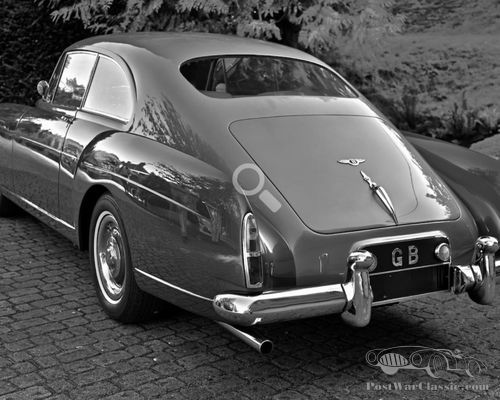
1957 Bentley S1 Fastback door H.J. Mulliner.
1957 Bentley S1 Fastback by H.J. Mulliner.Recent volledig gerestaureerd en bekroond exemplaar, in een staat die vrijwel gelijk is aan nieuw...
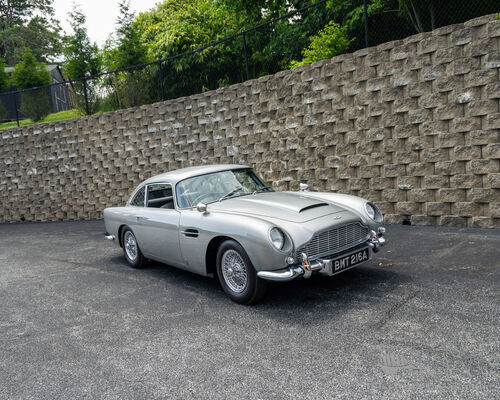
2020 Aston Martin DB5 Goldfinger Continuation
Wordt geveild door RM Sotheby's tijdens The Monterey Auction, 13–15 augustus 2026. Geschatte opbrengst: USD 1.000.000 – 1.500.000..
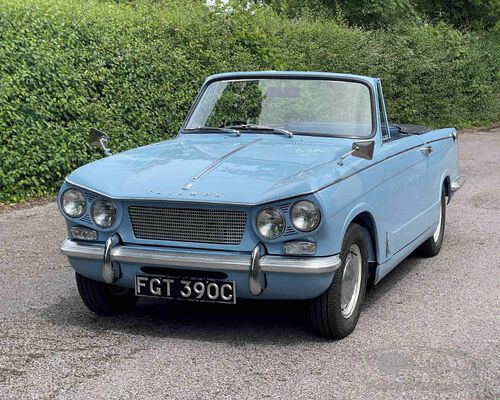
Triumph Vitesse 6 Convertible
Technische specificatiesMerk & model: Triumph Vitesse 6 ConvertibleBouwjaar: 1965Kenteken: Britse registratie