Het wereldwijde magazine en verkoopplatform voor liefhebbers van klassieke auto’s, door liefhebbers.
Het wereldwijde magazine en verkoopplatform voor liefhebbers van klassieke auto’s, door liefhebbers.


Maak een keuze
- Auto's
-
Merk >>
-
Bouwjaar >>
-
-
Categorie >>
- Motorfietsen
-
Bouwjaar >>
-
- Onderdelen
-
Automerk >>
-
Fabrikant >>
-
Categorie >>
-
Landen



De marktplaats: alle oldtimers te koop
Overzicht van gerelateerde advertenties 1946 Jaguar SS100 3.5 Litre Rebody from 1946 Jaguar 2.5 Litre Saloon.
-

1989 Jaguar XJS V12 Convertible (5.3 litre) | Windsor View Lakes Sale - July 2023 | Historics Auctioneers
The Jaguar XJS was first launched in 1975, in the year that Margaret Thatcher was made the leader of the Conservative Party and petrol was 70p/gallon. The new grand tourer from Jaguar was introduced as the replacement for the iconic E-Type, which had been in production for the previous 14 years. During an astonishing build run of 21 years, 115,413 ..1989JaguarXJS V12 Convertible (5.3 litre)VERKOCHT -
1973 Jaguar XJ6 Series I (4.2 litre) | Windsor View Lakes Sale - July 2023 | Historics Auctioneers
Launched in September 1968, the Jaguar XJ6 was the final model that Sir William Lyons had a, hands-on, input into the design. This new model was the result of several years of development and streamlined the extensive portfolio of models offered by Jaguar at the time. This new, reasonably priced car, managed to retain the principles of earlier Jagu..1973JaguarXJ6 Series I (4.2 litre)VERKOCHT -
1968 Jaguar E-Type Series I 2+2 Coupé | Windsor View Lakes Sale - 22 July 2023 | Historics Auctioneers
The E-Type design owed much to that of the racing D-Type, a monocoque tub forming the main structure while a tubular spaceframe extended forwards to support the engine. Conceived and developed as an open sportscar, the Jaguar E-Type debuted at the Geneva Motor Show in March 1961 in coupé form. The car caused a sensation, spontaneous applause breaki..1968JaguarE-Type Series I 2+2 CoupéVERKOCHT -
1962 Jaguar Mk. X | Windsor View Lakes Sale - July 2023 | Historics Auctioneers
The Jaguar Mk. X was the top of the range saloon car built by the British manufacturer primarily aimed at the United States market. The unitary construction bodyshell was codenamed 'Zenith' during development and this floor pan continued in production long after Mk. X production ended, as the DS420 Limousine. The interior was the last Jaguar with a..1962JaguarMk. XVERKOCHT -
2004 Jaguar XK8 Convertible | Windsor View Lakes Sale - July 2023 | Historics Auctioneers
Jaguar was founded as the Swallow Sidecar Company by Sir William Lyons in 1922, originally making motorcycle sidecars before developing passenger cars. The name was changed to Jaguar after World War II to avoid the unfavourable connotations of the SS initials. Sale to BMC happened in 1966, which in 1968 merged with Leyland Motor Corporation and bec..2004JaguarXK8 ConvertibleVERKOCHT -
1949 Triumph 2000 Roadster | Windsor View Lakes Sale - July 2023 | Historics Auctioneers
The Triumph Roadster was produced by Britain's Standard Motor Company from 1946 to 1949. It was first available as the Triumph 1800 Roadster from 1946 to 1948 and then as the Triumph 2000 Roadster from 1948 to 1949. Triumph had been purchased by the Standard Motor Company in 1944 and the managing director of Standard, Sir John Black, wanted a sport..1949Triumph2000 RoadsterVERKOCHT -
1946 Jaguar Mk. IV | Windsor View Lakes Sale - July 2023 | Historics Auctioneers
The 1945-1948 Jaguar Mk. IV was Jaguar's first car after World War II and was essentially continuations of the 1938-39 models. Very few of these cars were built for the right hand drive markets as steel was being rationed for goods for export. The origin of the name is rather odd since, back in 1948, there had been no Mk. I to IV Jaguars; the Mk. I..1946JaguarMk. IVVERKOCHT -
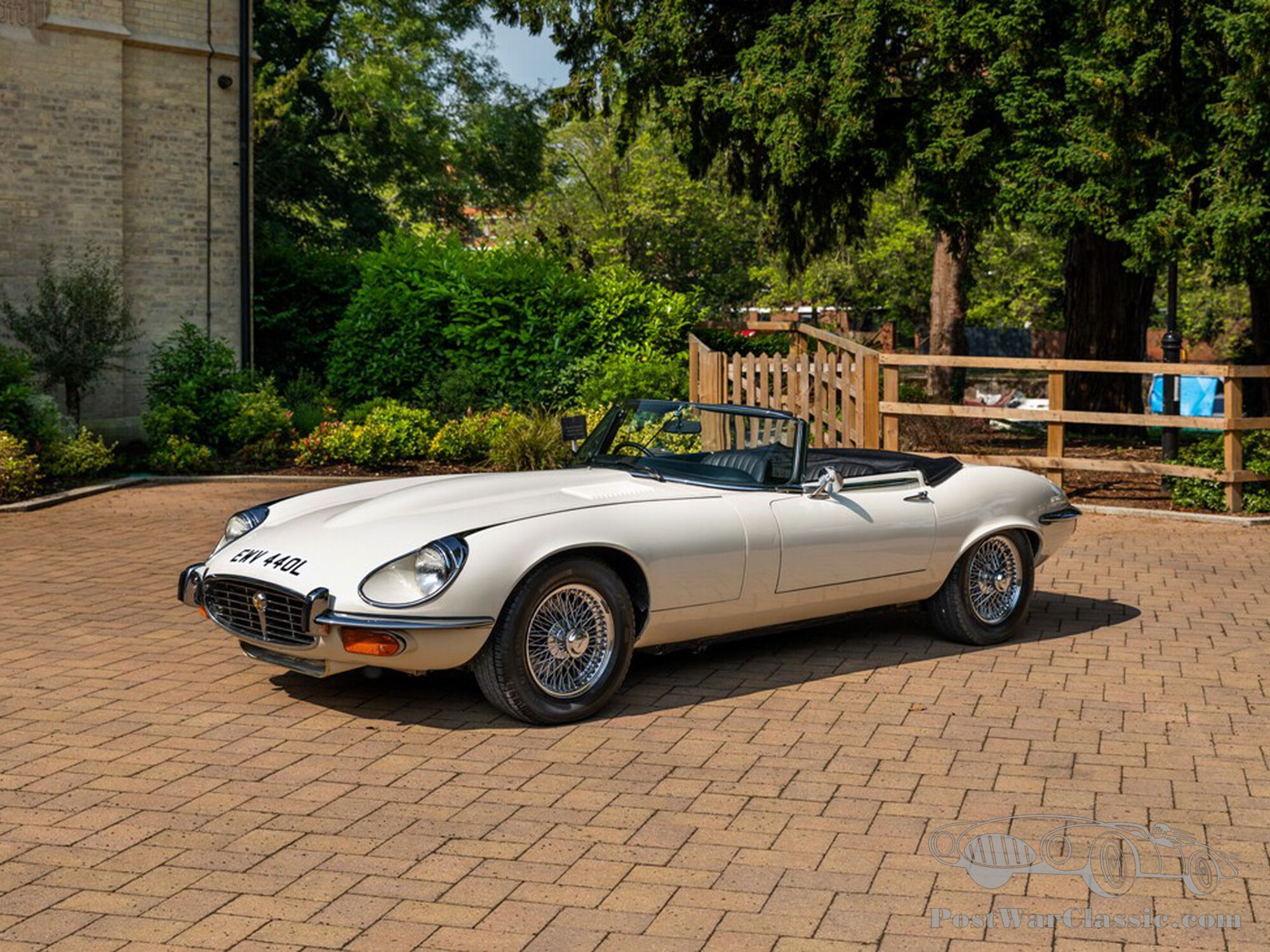
1973 Jaguar E-Type Series III Roadster | Windsor View Lakes Sale - July 2023 | Historics Auctioneers
The E-Type Series III was introduced in 1971, with a new 5.3 litre, V12 engine, uprated brakes, and power steering as standard. Optionally, an automatic transmission, wire wheels and air conditioning were available. The brand new V12 engine produced 272bhp, had increased torque, and a 0-60mph time of less than seven seconds, which was phenomenal fo..1973JaguarE-Type Series III RoadsterVERKOCHT -
2009 Jaguar X-Type Estate Ex-HM Queen Elizabeth II | Windsor View Lakes Sale - July 2023 | Historics Auctioneers
The Jaguar X-Type is a front-engine, all-wheel/front-wheel drive compact executive car manufactured and marketed from 2001 to 2009. In addition to offering Jaguar's first estate in series production, the X-Type would ultimately introduce its first diesel engine, four-cylinder engine and front-wheel drive configuration. The X-Type was developed dur..2009JaguarX-Type Estate Ex-HM Queen Elizabeth IIVERKOCHT -
1962 Jaguar E-Type Series 1 3.8-Litre Roadster | RM Sotheby's | Monterey
To Be OFFERED AT AUCTION WITHOUT RESERVE at RM Sothebys' Monterey event, 17 - 19 August 2023. Sold | $246,400 USD Offered from The Iannelli Family CollectionCoveted early E-Type roadster wearing several performance enhancements3.8-liter, inline-six engine and cylinder head fed by a trio of two-barrel Weber carburetors; ..1962JaguarE-Type Series 1 3.8-Litre RoadsterVERKOCHT