Het wereldwijde magazine en verkoopplatform voor liefhebbers van klassieke auto’s, door liefhebbers.
Het wereldwijde magazine en verkoopplatform voor liefhebbers van klassieke auto’s, door liefhebbers.





De marktplaats: alle oldtimers te koop
Overzicht van gerelateerde advertenties 1972 Ferrari 365 GTC4 by Pininfarina
-

1979 Ford Bronco Ranger XLT | Amelia Island Auctions | Gooding & Co | March 2-3, 2023
First sold to the public in August 1965, Ford’s Bronco was one of the earliest examples of a sport utility vehicle and became an American icon. Designed to better compete in a growing utility market, the second generation was unveiled in 1978 as a larger truck with improved on-road manners. Based on a shortened version of the F-100 4x4 pickup, t.. -
1962 Ferrari 250 GT SWB California Spider | Amelia Island Auctions | Gooding & Co | March 2-3, 2023
In late 1957, just as production of Pinin Farina’s Series I Cabriolet was getting underway, Ferrari was in the process of developing a new open 250 GT variant for the booming North American market. Ferrari’s leading US dealers, Luigi Chinetti and John von Neumann, impressed upon the factory the need for a simple, dual-purpose 250 GT Spider – a c.. -
1974 Porsche 911 Carrera 2.7 | Amelia Island Auctions | Gooding & Co | March 2-3, 2023
For the 1974 model year, Porsche’s flagship 911 received significant updates to comply with new safety and emissions rules in the US. The new G series featured a shorter hood, impact-absorbing bumpers, a rear reflective panel with Porsche lettering, and three-point safety belts. A new Carrera model was also introduced and offered to American buy.. -
1974 Lancia Stratos HF Stradale | Amelia Island Auctions | Gooding & Co | March 2-3, 2023
The story of Lancia’s most memorable postwar sports car begins at the 1970 Torino Motor Show, where Carrozzeria Bertone unveiled the dramatic new Stratos Zero concept. With its bold wedge shape, futuristic front-hinged door, and mid-mounted Fulvia powerplant, Bertone’s prototype was the star of the show and attracted the interest of Lancia direc.. -
1964 Ferrari 500 Superfast | Amelia Island Auctions | Gooding & Co | March 2-3, 2023
The hands-down headline attraction among the 15 new designs exhibited by Pininfarina at the March 1964 Geneva Motor Show was the Ferrari 500 Superfast, which debuted as a larger, more powerful, and even more luxurious replacement for the 400 Superamerica. Based on its speed, power, and extreme cost, it captured the public’s imagination in a mann.. -
1977 Porsche 934/5 | Amelia Island Auctions | Gooding & Co | March 2-3, 2023
Launched in 1976, the 934 was built by Porsche to compete in the FIA’s Group 4 GT class, replacing the venerable Carrera RSR 3.0. While the new model was based on the production 930 Turbo, very little – aside from the road car’s body shell and engine case – remained unchanged in the transformation to race-ready 934. FIA regulations requ.. -
1967 Ferrari 275 GTB/4 | Amelia Island Auctions | Gooding & Co | March 2-3, 2023
In October 1964, the 275 GTB made its landmark debut at the Paris Motor Show alongside its open 275 GTS stablemate to replace the outgoing and long-running 250 GT and its many variants. The 275 GTB signaled an important evolution in Ferrari road cars, as it had a fully independent suspension layout, which had been tested, developed, and proven o.. -
1979 Pontiac Firebird Trans Am | Amelia Island Auctions | Gooding & Co | March 2-3, 2023
1979 saw a major transformation for Pontiac’s beloved Firebird, featuring a completely restyled body with improved aerodynamics, larger fender flares, and an enhanced rear spoiler. It also marked the end of the line for big-block V-8s from Pontiac with the optional 400 cid W72 V-8 engine. Claimed by Pontiac to produce 220 hp and 320 lbs./ft. of .. -
1973 Porsche 911 Carrera RS 2.7 Touring | Amelia Island Auctions | Gooding & Co | March 2-3, 2023
First developed to homologate the 911 for Group 4 racing, the Carrera RS 2.7 marked many firsts for Porsche. Launched in 1972, customers could choose from Touring and Lightweight models, both of which offered significant performance and weight savings over the standard 911S. Weight savings came by way of lighter-gauge sheet metal, thinner window.. -
1958 Ferrari 250 GT Tour de France Berlinetta | Amelia Island Auctions | Gooding & Co | March 2-3, 2023
In 1956, Ferrari responded to the FIA’s new GT Class championship by creating a dual-purpose, road-racing model based on the 250 GT. With a competitiontuned, three-liter V-12 and lightweight aluminum coachwork by Carrozzeria Scaglietti, the resulting 250 GT Berlinetta was a potent force in sports car racing through the late 1950s. The n..


Uitgelicht
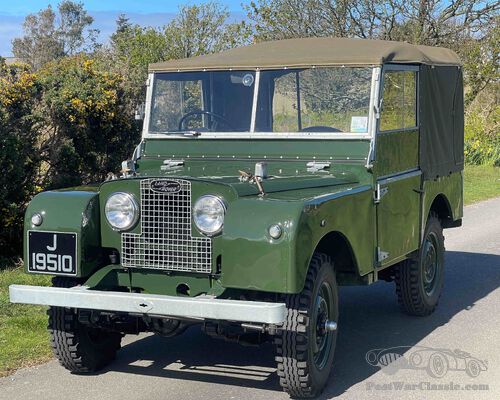
1952 Land Rover Series 1
Technische specificaties:Merk en model: Land Rover Series !Bouwjaar: 1952Kenteken: geregistreerd in ..
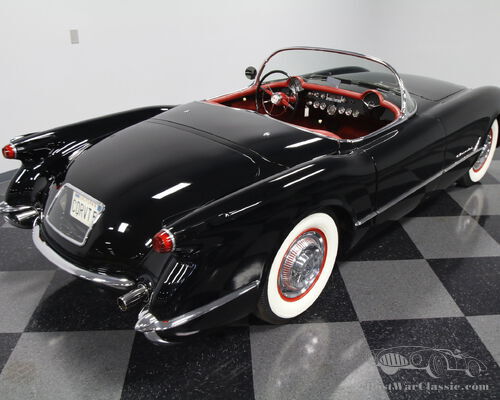
1954 Chevrolet Corvette C1
Fully restored 1954 C1 Corvette in Black. Stunningly beautiful car, feels like driving a sculptural work of Art. Known to be the oldest Corvette on t..
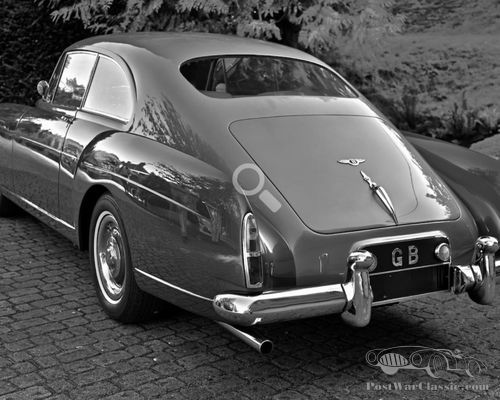
1957 Bentley S1 Fastback door H.J. Mulliner.
1957 Bentley S1 Fastback by H.J. Mulliner.Recent volledig gerestaureerd en bekroond exemplaar, in een staat die vrijwel gelijk is aan nieuw...