Het wereldwijde magazine en verkoopplatform voor liefhebbers van klassieke auto’s, door liefhebbers.
Het wereldwijde magazine en verkoopplatform voor liefhebbers van klassieke auto’s, door liefhebbers.





De marktplaats: alle oldtimers te koop
Overzicht van gerelateerde advertenties 1972 Ferrari 365 GTC4 by Pininfarina
-

1972 Ferrari 365 GTB/4 Daytona Spider | Amelia Island Auction | Gooding & Company | March 1, 2024
Debuted in Paris in 1968, the 365 GTB/4 succeeded the 275 GTB/4 as Ferrari’s new top-of-the-line, two-seat gran turismo. Almost immediately, it was unofficially known as the “Daytona” in honor of Ferrari’s podium sweep at the 1967 24 Hours of Daytona, and it stands as the last front-engine, V-12 GT model designed before Fiat’s takeover of Ferrar.. -
1966 Ferrari 330 GT 2+2 Coupe | Amelia Island Auction | Gooding & Company | March 1, 2024
During its first 10–15 years of existence, Ferrari transitioned from a boutique builder of road cars to a genuine small-scale manufacturer. This growth meant more revenue to spend on racing, and it necessitated the evolution of Ferrari road cars from barely disguised race cars to something that would appeal to discerning buyers beyond the advent.. -
1954 Ferrari 500 Mondial Series I Spider | Amelia Island Auction | Gooding & Company | March 1, 2024
In December 1953, Ferrari unveiled its first four-cylinder production sports car – the 500 Mondial, named in honor of Alberto Ascari’s back-to-back World Championships. Like Ascari’s 500 F2 Monoposto, the Mondial featured a two-liter, twin-cam, four-cylinder engine designed by Aurelio Lampredi. Known internally as the tipo 110, this eng.. -
1974 Maserati Bora 4.9 | Amelia Island Auction | Gooding & Company | March 1, 2024
Deceptively comfortable, sophisticated, and usable, Maserati’s mid-engine Bora surpassed Lamborghini’s groundbreaking Miura in several key respects and predated Ferrari’s 365 GT4 Berlinetta Boxer by several years. Designed by Giorgetto Giugiaro and masterfully engineered by Giulio Alfieri, the Bora was Maserati’s first monocoque-based r.. -
1971 Mercedes-Benz 280SE 3.5 Cabriolet | Amelia Island Auction | Gooding & Company | March 1, 2024
One of the most glamorous automobiles of any era, the Mercedes-Benz 280SE 3.5 Cabriolet is an extraordinary true four-passenger convertible, and just 1,232 were produced from August 1969 through July 1971. Built with no cost spared using extensive hand labor, these high-style, V-8-powered machines were aimed squarely at elite buyers in the US an.. -
1974 Citroën SM | Amelia Island Auction | Gooding & Company | March 1, 2024
A fascinating combination of ingenious oleo-pneumatic, self-leveling suspension, elegant avant-garde styling by Robert Opron, and an exotic, quad-cam Maserati V-6, the Citroën SM remains among the most distinct and desirable GT cars of the past half century. The SM offered here is one of 134 examples originally built for the US market t.. -
2005 Ferrari 575 Superamerica | Amelia Island Auction | Gooding & Company | March 1, 2024
The front-engine V-12, reintroduced to the Ferrari lineup with the 550 Maranello, was strengthened with the 575, which was launched for the 2002 model year. Although its striking Pininfarina silhouette only featured minor revisions, the true advancements came in the form of a larger 5.75-liter V-12 engine, as well as improved weight distribution.. -
1977 Ferrari 308 GTB | Amelia Island Auction | Gooding & Company | March 1, 2024
Achingly beautiful with Pininfarina-designed bodywork, the V-8 Ferrari 308 continues to be recognized as one of Maranello’s finest modern road cars. Launched at Paris in 1975, the gorgeous 308 replaced the outgoing V-6 Dino 246 and, soon after, the Bertone-designed 308 GT4. The first 712 “Vetroresina” examples were bodied in fiberglass, with th.. -
2000 Ferrari 550 Maranello | Amelia Island Auction | Gooding & Company | March 1, 2024
The front-engine, two-seat, V-12 grand tourer has long been a vital part of Ferrari’s DNA. The 1980s saw a gap in Ferrari’s lineup for such a model – with the acclaimed 365 GTB/4 Daytona being phased out in the early 1970s. That was until the introduction of the 550 Maranello at the Nürburgring in July 1996 some 23 years later. The heritage woul.. -
2004 Ferrari 575M | Amelia Island Auction | Gooding & Company | March 1, 2024
Building on the already successful grand touring recipe of the 550 Maranello, the 575M was unveiled in 2002 at the Geneva Motor Show. Placed behind the 575 nomenclature on its rear deck lid was a distinctive “M” which stood for “modified,” denoting its numerous updates over the outgoing 550. Revised styling, improved weight distribution, and a h..


Uitgelicht
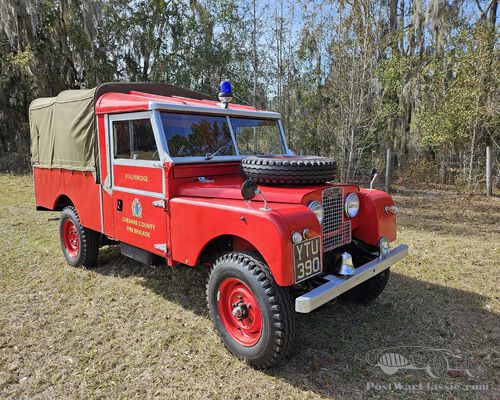
1957 Series 1 Land Rover Fire Engine + Coventry Climax Godiva Fire Pump
Betsy was used by Cheshire Fire Service (UK) from 1957 to 1975. She was based at Hazel Grove and Stalybridge Fire stations. She comes with an exten..

Rolls-Royce
Rolls-Royce Silver Wraightlinks gestuurd, automatic, stuurbekrachtigingkleur antraciet grijs, lopende auto op Nederlands kenteken